
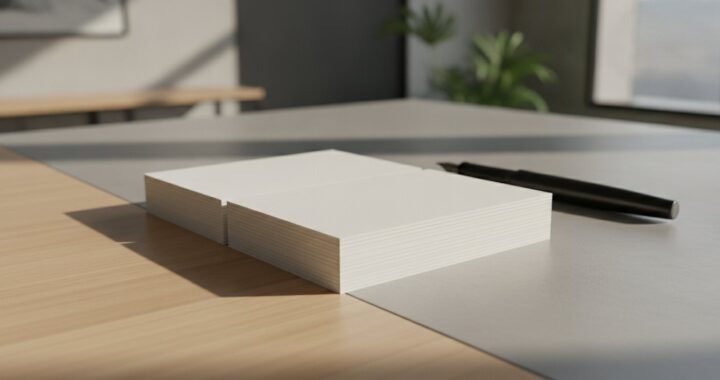
Market research shows standard uncoated business cards typically range from $11 to $100 depending on paper weight and order volume. Choosing writable paper (uncoated cardstock) ensures a tactile finish that is easy to write on without ink smearing. To help you meet urgent deadlines, London City Print supplies eco-conscious stocks alongside business cards within one hour.
Key Takeaways: Uncoated business cards provide a tactile, absorbent surface ideal for writing notes or appointment details without ink smearing, unlike glossy or matte coated stocks.
- Standard weights range from 350gsm to 400gsm, while 450gsm boards offer maximum tactile impact.
- Except when using dark full-bleed designs, as unsealed fibres show edge wear and scuffs faster.
- Choose uncoated stock for service brands needing writability and a natural, glare-free professional look.
- The article details how ink absorption darkens CMYK shadows, requiring specific file prep adjustments.
Writable cardstock that protects your first impression
Selecting the right paper grade shapes how clients read your brand in the first seconds of a meeting. Three situations come up often:
- You and your team jot follow-up notes on the card during the meeting: pick writable paper so ink absorbs at once and does not smear.
- You are walking into a high-stakes pitch where the card has to feel substantial: move up to a heavier board or a 600gsm same-day card when presentation weight matters.
- You need cards before close of play: use a central London same-day or one-hour route instead of risking a missed courier window.
With clients we see that standard materials fail when notes have to go straight onto the card. Uncoated surfaces absorb ink without smearing, which is why consultants who write during meetings lean on a natural look (business stationery), while coated media still suits image-heavy layouts.
"We are a local firm of property consultants and chartered surveyors and Londo
Thicker boards add durability when the handshake is high pressure. Basic short-run sets sit in the broad market band reported above, with price driven by weight and volume. You avoid missed deadlines and ruined runs by printing at a facility near the British Museum in Central London, where production machines run at up to 100 pages a minute and keep urgent orders moving.
As recorded in Wikipedia’s business card history (2025), portable contact credentials have conveyed commercial status for centuries. We run pre-flight file checks on crop marks, bleed areas, and your CMYK colour profile before press. For short runs under 500 units, digital printing keeps turnaround tight. Submit your artwork for rapid production when the meeting is already in the diary.
Heavier gsm grades that feel solid in the hand
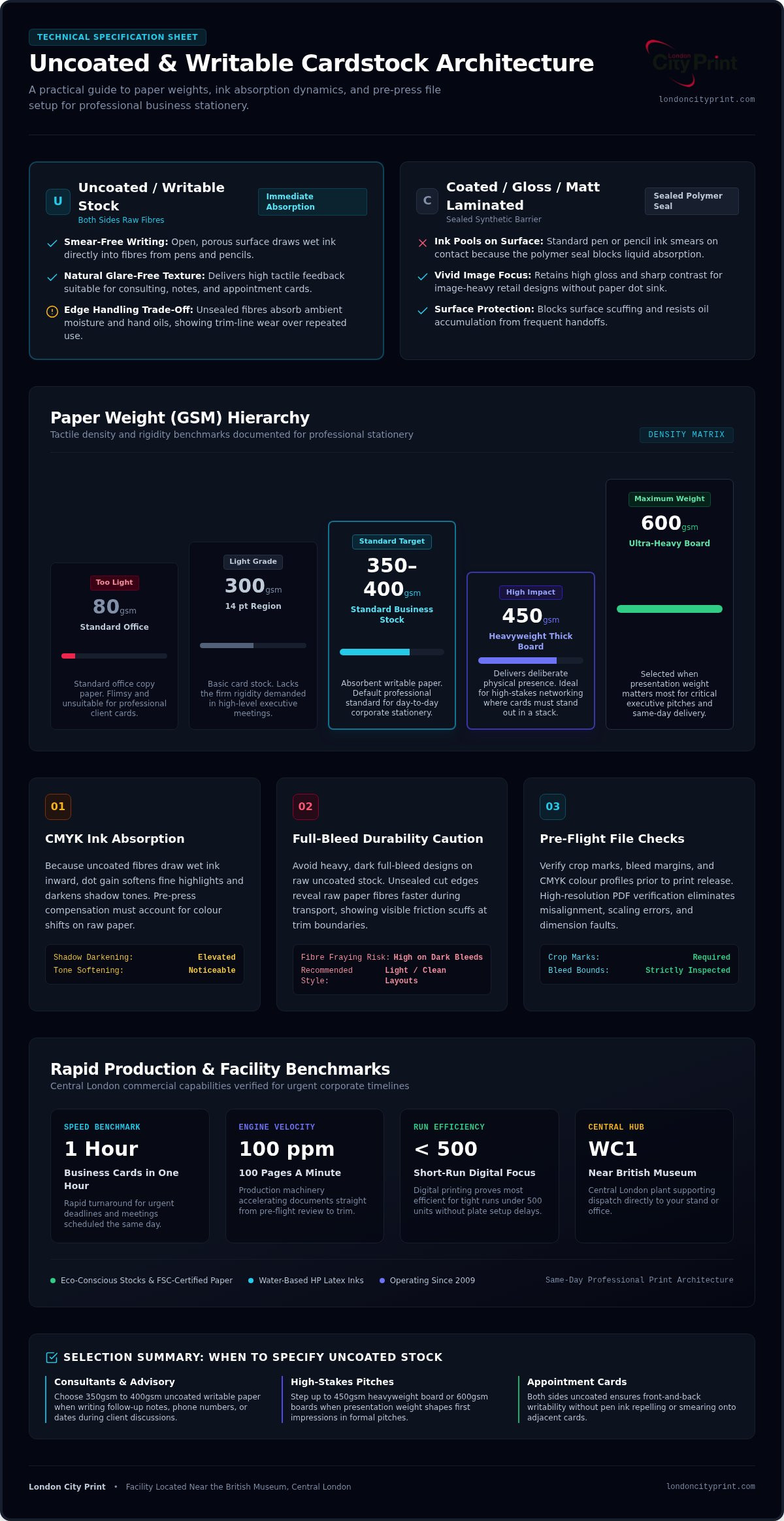
Uncoated business cards typically sit in a business card paper weight range between 350gsm to 400gsm, which is where most day-to-day professional sets land.
| Paper Option | Target Weight Range | Surface Characteristic |
|---|---|---|
| Standard Business Stock | 350gsm to 400gsm | Absorbent writable paper |
| High-Impact Premium Stock | 450gsm | Heavyweight thick paper |
This natural look stock draws ink into the fibres, so you get a tactile texture without glare. Heavy 450gsm boards add physical presence that helps your brand stand out in a stack; do not treat 450gsm as the same thing as lighter 14 pt grades, which sit nearer the 300gsm region. Standard office paper sits at 80gsm, which is too light for high-impact marketing. An unlaminated 400gsm stock works well when your team writes on cards often; high-gloss coatings remain the better match for image-led designs.
If you need cards before the afternoon meeting, the team can print cards within one hour at the Central London site near the British Museum. Digital machinery at up to 100 pages a minute takes files from pre-flight checks straight to trim. Delivery can go to your stand or office when the clock is tight.
Working with local corporate clients shows how tactile weight shapes first impressions in live meetings. Choose 450gsm when you are handing cards out at dense networking sessions and you want the stock to feel deliberate in the recipient’s hand. London City Print holds turnaround steady when each minute counts; request timing on your run before you lock the event slot.
Tip: Choose 450gsm stock when handing out cards at high-stakes networking events to make a lasting tactile impression.
Both sides uncoated so ink dries as you write
Uncoated paper carries an untreated texture on both sides, so a standard pen or pencil writes cleanly on either face.
This natural look suits appointment cards because ink dries without smudging. Writable paper pulls wet ink in through its porous surface. When the brief is same-day, order one-hour business cards from the shop near the British Museum. A firm thick sheet still gives clear tactile feedback while holding colour accuracy on press.
Ink absorption on raw fibres can soften your CMYK colour profile and shift fine tones, so build that into the design, not after the proof. During pre-flight file checks, technicians regularly catch setup errors before they reach the press. Digital printing reduces faults such as wrong dimensions, lost air release, mid-print disconnections, and incomplete curing when calibration and machine speed are set correctly.
Uncoated options fit service brands that write on the card; high-gloss finishes fit image-focused retail layouts. Incomplete curing is a separate press topic: a commenter in the printplanet.com thread "Forum list" asked:
"Why is UV ink not fully cured in flexo printing?" (source)
Incomplete curing appears when UV lamp intensity drops or ink thickness exceeds normal penetration. Proper pre-press calibration and accurate machine speed prevent those drying failures. Send your file through pre-flight before you commit the run so writability and colour both land as planned.
Durability limits of uncoated stock over repeated handling
Writable paper takes up ambient moisture and hand oils faster than Laminated alternatives. In the print shop, unsealed fibres fray along trimmed edges after frequent handling because the sheet has no plastic barrier.
Without a coating, ink sits inside the fibres, which speeds surface wear. Unprotected cards pick up wallet dirt quickly, and dark full-bleed backgrounds show edge wear first. Market listings place general short-run stock in a wide $11-100 band driven by weight and quantity, so budget for replacements if cards live in heavy rotation.
Print failures put events, customers, and commitments at risk when cards degrade before a trade show. If stock is already damaged and you need a replacement set the same day, order cards within the hour and protect the deadline. A natural look fits eco-focused brands; a thicker board with a matte path suits high-contact networking where the card changes hands often.
Unprotected fibres show scuffs faster than film-laminated cards. That is a materials limit, not a press fault, and it pushes some buyers toward non-porous substrates. A commenter in the signs101.com thread "Digital Printing, Forums" wrote:
"How to UV Reverse Print on Thin Plexi, Self Adhesive?" (source)
Reverse printing on thin plexiglass with self-adhesive film means mirroring artwork in pre-press before printing to the adhesive side. UV-curable inks bond to non-porous surfaces without liquid absorption. For everyday networking cards, decide up front whether writability or scuff resistance matters more, then match the stock to that use.
File prep that stops uncoated colours from going flat
Artwork for writable paper needs tight layout parameters so a looming deadline does not turn into a reprint. Ink moves into natural fibres faster than into glossy coatings, which darkens shadow areas; adjust the file before submission so the print does not look flat.
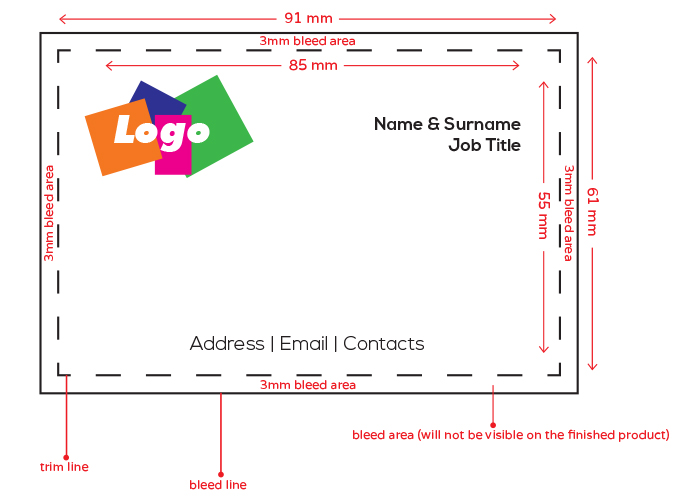
- Set your dimensions: Create your document at exact custom dimensions with 3 mm bleed added to every edge.
- Convert to CMYK: Change your colour space from RGB to a CMYK colour profile to ensure accurate physical ink representation.
- Embed all assets: Vectorise your typography and link all images at 300 dots per inch (DPI) to avoid resolution issues.
- Export high-resolution PDFs: Save your finished file using standard high-resolution PDFs with explicit crop marks included.
The London City Print team runs pre-flight file checks near Holborn on bleed, resolution, and font embedding before press. That check is what stops expensive errors from entering the queue. If the deadline is close and the file still feels uncertain, pre-press can correct layout issues so your business stationery prints cleanly on the first pass. Upload the PDF with crop marks and 3 mm bleed, then ask for a timed slot on press.
Frequently asked questions
What are uncoated business cards?
Uncoated business cards use writable paper that lacks any plastic film or liquid varnish. You get an absorbent texture that takes full-colour CMYK ink into the fibres. The tactile finish lets you add personal notes or signatures with standard pens without smudging. The central London facility near the British Museum prints these on digital presses when you need them quickly.
Is matte or uncoated better for business cards?
Uncoated stock gives a natural look with strong writability; matte stock gives a smoother sealed feel. Your choice depends on how the team uses the cards. Pick uncoated if you stamp loyalty details or write appointments on the surface. Pick matte coated paper if the design needs dense, vibrant ink coverage. Digital samples are available so you can compare both textures before a full run.
What is the difference between coated and uncoated cardstock?
Coated paper carries a polymer layer that holds ink on the surface; uncoated stock leaves the paper fibres open. Standard office paper at 80gsm is too light for high-impact marketing. For business cards, premium weights from 350gsm to 400gsm are standard, with bespoke 450gsm boards when you want more mass in the hand. Coated stocks produce a high-gloss or smooth seal; uncoated paper gives a textured write-on feel. Pre-flight file checks confirm the artwork matches the stock you chose.
What is the starting price for uncoated business cards?
Final cost depends on paper weight, custom dimensions, quantity, and production speed. Request a personalised quote against your exact artwork parameters. Digital printing is efficient for short runs under 500 units, which suits smaller orders. FSC-certified eco-conscious stocks and custom finishing also change the total. Contact the London team for a tailored estimate timed to your deadline.
How fast can I get uncoated business cards in central London?
Same-day and one-hour routes run from the Central London facility near the British Museum when your file passes pre-flight. Machines at up to 100 pages a minute move short digital runs from check to trim without holding for long make-readies. Plan bleed, CMYK, and 300 DPI images before you upload so the clock spent on corrections stays low. Ask for the next available slot when you send the PDF.
Reliable printing in 2026
Writable paper still earns its place when you need a tactile card you can write on in the room. The decision line is unchanged from the open: pick uncoated for notes and a natural feel, set the gsm to the impression you want, and use a fast central London path when the date will not move.
Choosing a natural look stops ink smudging when appointment details go straight onto the card, because porous fibres take ink quickly. Keep high-resolution PDFs with crop marks, a CMYK colour profile, and 3 mm bleed so the sheet matches the file. The Central London facility processes urgent digital orders on short deadlines.
Place your uncoated business card order through London City Print professional printing services when you need production that keeps pace with the meeting calendar.