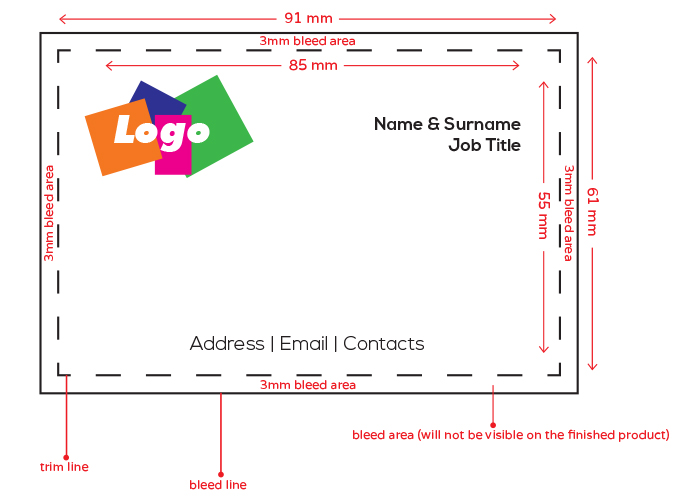


A brilliant technical proposal can lose critical marks before scoring even begins if poor presentation frustrates the evaluation panel. Professional tender document printing and binding isn’t just about final assembly; it directly drives evaluator usability. You already know the high-stakes pressure of strict procurement deadlines, where complex submissions combining narrative text with foldout A3 schematics leave zero margin for mechanical errors, misaligned tabs, or non-compliant formatting.
You shouldn’t have to worry about whether clipped margins or blurred graphics will hurt your bid score. In this guide, you’ll discover how to choose the right paper stocks, section tabs, and finishes to produce compliant, high-scoring tender submissions. We cover everything from wire binding and PUR binding thresholds to pre-flight file checks on high-resolution PDFs, giving you the technical precision needed to submit flawless proposals on time.
Key Takeaways
- Select optimal interior and cover paper weights to eliminate ink show-through and protect foldout schematics during intense panel reviews.
- Choose the correct mechanical finish by understanding when professional tender document printing and binding requires lay-flat wire binding versus square-spine PUR binding.
- Structure your document navigation with custom tabbed dividers that mirror the procurement matrix, helping evaluators locate mandatory compliance criteria quickly.
- Prevent immediate submission disqualification by running pre-flight file checks that resolve font embedding, bleed margins, and scaling errors before production.
- Meet zero-margin deadlines by securing an agile Central London print partner set up for rapid digital runs under 500 units.
Technical Specifications for Compliant Tender Document Printing
Procurement evaluators review submissions under strict time constraints, scoring your proposal against rigid assessment matrices. While budget reprographics often rely on thin 75 gsm or 80 gsm copy paper, standard office copy sheets cause significant ink show-through on double-sided text blocks. Flawless tender document printing and binding requires technical precision to ensure every page maintains high visual contrast and structural resilience under rapid review.
To establish an authoritative visual hierarchy, standardize your core narrative on 100 gsm to 120 gsm uncoated or silk text stock. These weights eliminate print show-through, preserve high-contrast typographic clarity, and handle frequent margin annotations comfortably. Encase your proposal volumes in durable 250 gsm to 350 gsm cover boards to shield internal pages against heavy handling. Following proven standards for professional document binding in London guarantees your submission arrives completely aligned with corporate and public-sector presentation expectations.
Selecting Paper Stocks and Eco-Conscious Materials
Public procurement frameworks and corporate invitations to tender increasingly score bids on environmental compliance. Using FSC-certified paper and certified eco-conscious stocks directly reinforces your ESG and social value criteria. Choose 120 gsm silk stock for sections featuring high-density photography or 3D renderings to enhance colour depth. For legal declarations, pricing schedules, and compliance appendices, specify 100 gsm or 120 gsm uncoated sheets to allow immediate note-taking with ballpoint pens or highlighters.
Managing Large-Format Technical Drawings and Foldouts
Complex bids regularly require multi-format content, pairing narrative chapters with wide architectural plans, Gantt charts, or schematics. Inserting standard A3 pages directly into an A4 volume leads to uneven edges or trapped text unless folded correctly. To ensure seamless review alongside mechanical document binding methods, implement structured foldouts:
- Concertina Z-folds: Fold A3 schematics to an exact 210 mm body width so the outer edge sits flush inside the closed volume, letting assessors unfold diagrams without detaching the sheet.
- Exact Scale Integrity: Never select “fit to page” within your printer driver. Output technical CAD plotting at exact 1:1 reproduction to protect 1:50 or 1:100 engineering scales.
- Binding Tolerances: Maintain a strict 10 mm to 15 mm clear gutter margin on the binding edge so punches or adhesives never clip critical drawing legends.
Aligning these technical paper specifications guarantees your tender document printing and binding delivers the clarity and structural polish needed to score top marks.
Choosing the Right Document Binding Method for Tender Submissions
How evaluators handle your submission physically affects their scoring experience. If a binder snaps shut or refuses to stay open while an assessor inputs scores, you introduce unnecessary friction. Selecting the right mechanical format for your tender document printing and binding ensures your proposal meets official UK public sector tendering guidelines while respecting limited desk space in evaluation rooms.
Wire Binding for Flat-Lay Evaluation
Twin-loop wire binding remains the top choice for standard bids under 250 sheets. Using metal wire combs allows true 360-degree rotation so assessors can fold the book back on itself or lay it completely flat while taking notes. Pair wire binding with clear protective acetate front covers and a solid backing board to guard against spills. For document pagination between 10 and 120 sheets, specify 3:1 pitch wire binding with 34 punched holes along an A4 edge. For thicker volumes up to 250 sheets, your print team should apply a 2:1 pitch gauge to ensure pages turn smoothly without binding tension.
PUR Binding for High Page-Count Proposals
When tender responses exceed 150 leaves or require an executive softcover presentation, PUR binding provides a polished book format. Polyurethane adhesive forms an exceptionally strong, flexible bond along the text block. Unlike traditional hot-melt adhesives, PUR does not crack or shed pages when opened repeatedly. It requires a text-block spine thickness of at least 3 mm, giving you a clean square spine where you can print volume numbers, project titles, and company branding for fast identification on an assessor’s shelf.
Custom Ring Binders and Lever Arch Presentation
Massive multi-volume submissions often require modular organization. Heavy-duty corporate four-ring binders and lever arch mechanisms excel when you must insert last-minute addenda or replace single pages before submission. You can pair presentation ring binders with matching protective slipcases and select custom finishing options such as matte lamination or spot UV to deliver an executive appearance. When tender deadlines leave zero margin for finishing defects, consult with London City Print to align your exact page counts with the ideal binding technique.
Navigation Architecture: Indexing, Tabbed Dividers, and Document Layout
Procurement evaluators mark responses against rigid scoring matrices under aggressive deadlines. If an assessor cannot instantly cross-reference your case studies with the stated award criteria, your submission loses momentum. Structuring an intuitive physical navigation system transforms your tender document printing and binding into a frictionless scoring tool that directs the reader straight to your strongest evidence.
Custom Mylar Tab Dividers and Section Mapping
Generic numbered tabs fail when dealing with complex, multi-envelope procurement responses. You need bespoke tabs that print exact section titles and reference codes matching the client’s Invitation to Tender (ITT). Adhere to the following layout specifications to maintain clean visual indexing:
- Tab Extension Width: Specify dividers with a tab extension of 12.7 mm to 13 mm beyond standard A4 trim width (210 mm body width extending to 222.7 mm or 223 mm total width). This ensures full visibility when the volume is closed.
- Protective Mylar Coating: Apply clear or coloured plastic mylar film to tab extensions. This coating eliminates dog-eared edges and tear-outs during frequent cross-referencing.
- Calculated Bank Systems: Choose 1/5-cut (5-bank) tabs for broader chapters or 1/10-cut (10-bank) tabs for granular compliance sections, ensuring tab titles remain legible without text crowding.
Pagination Rules and Avoiding the Fit to Page Scaling Trap
Synchronizing your physical proposal with your digital submission is mandatory. If an assessor references page 42 from your table of contents, your physical page 42 must deliver that exact content. Never let software defaults introduce unnumbered interstitial divider pages that break your pagination sequence.
Document dimensions must strictly respect ISO 216 standard paper size specifications to maintain geometric fidelity. Ensure your artwork files output at true 100% scale rather than shrinking under printer driver automation. Selecting “fit to page” recalculates your layout by roughly 94% to 97%, altering technical margins and invalidating drawing scales on A3 foldouts. Design your files so every major section opens predictably on a right-hand, odd-numbered leaf. When setting up double-sided spreads, alternate running headers and footers to keep section titles aligned with the outer page edges.
Precise document architecture reassures the evaluation board that your team operates with disciplined attention to detail across every facet of your bid.
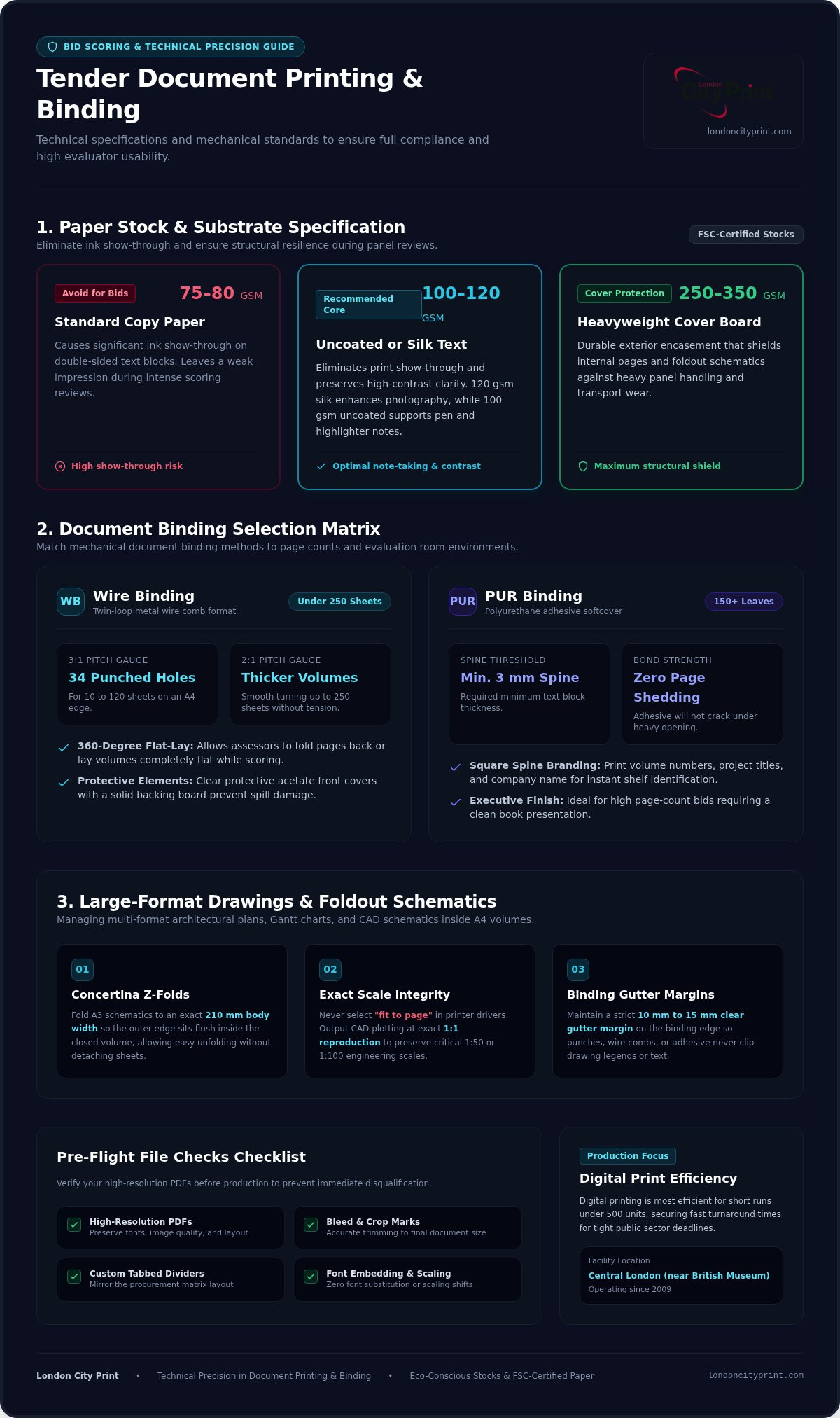
Avoiding Critical Production Errors Under Tight Submission Deadlines
Public procurement authorities enforce zero-tolerance policies for late submissions. If your production run hits a technical roadblock two hours before the deadline, your team faces immediate disqualification. While automated upload portals catch file corruption, they routinely miss subtle formatting flaws that cause misaligned prints. Protecting your submission requires strict pre-flight file checks before your data touches a commercial digital press.
Pre-Flight File Checks and Artwork Preparation
Submitting unverified artwork invites production delays. Export your proposal files as high-resolution PDFs compliant with PDF/X-4 (ISO 15930-7:2010) or PDF/X-1a standards. This ensures native transparency flattening and embeds 100% of your fonts, preventing the digital front-end RIP software from substituting typefaces. Build your layout files using these essential production parameters:
- Bleed and Crop Marks: Include a full 3 mm bleed on all outer edges alongside precise crop marks. This gives the industrial guillotine adequate tolerance to trim pages cleanly without leaving white slivers along coloured headers or edge tabs.
- Gutter Allowances: Keep critical text, icons, and page numbers at least 10 mm to 15 mm away from the inner spine edge to prevent binding teeth or PUR glues from obscuring data.
- Resolution Discipline: Debunk the 300 DPI myth when handling oversized schematics. While narrative text blocks and standard photography require 300 DPI at 1:1 scale, large-format graphics and CAD schematics frequently print with razor-sharp technical precision at 150 to 200 DPI, saving file size and processing time.
Colour Profiles and Digital Samples
RGB profiles display brilliant light on back-lit computer monitors, but commercial digital presses print using CMYK toner and ink pigments. If you submit unmanaged RGB artwork, automated press conversions can shift your corporate navy to a muted purple. Convert all artwork elements into standard CMYK colour spaces prior to file export.
Reviewing physical digital samples remains the most dependable method to verify colour fidelity across diverse paper textures and check for double-sided registration errors. If you are preparing modular bid packs or supplementary company profiles, review our guide on professional booklets and brochures for advanced layout advice. When deadline windows shrink to hours rather than days, request a rapid file-checking service with London City Print to guarantee compliant tender document printing and binding before final output.
Procuring Your Tender Print with London City Print
Submitting a winning bid requires flawless execution when deadlines converge. When procurement portals close at noon, executing time-critical tender document printing and binding requires an agile reprographics specialist rather than a remote regional warehouse. London City Print operates high-speed digital engines running at up to 100 pages a minute, delivering rapid turnaround times without sacrificing typographical clarity. For tender proposals, digital printing is most efficient for short runs under 500 units, providing sharp contrast, flexible collation, and immediate mechanical finishing.
Partnering with dedicated professional printing services in London gives your bid team immediate access to high-spec stocks, heavy cover boards, and calibrated binding equipment tailored for high-stakes corporate reviews.
Central London Facility and Rapid Turnaround
Operating since 2009 from our facility located near the British Museum, our production centre sits minutes away from major commercial headquarters, government offices, and legal districts. We offer a same day printing service in Central London available 24 hours a day, Monday to Sunday. Whether you need five bespoke presentation sets or fifty multi-volume packages, our location eliminates long-distance transit risks. As soon as your books clear quality control, we arrange direct courier dispatch straight to the buying team or procurement department to guarantee on-time arrival.
File Submission and Dedicated File-Checking Service
Technical flaws discovered on the press floor can stall your entire project. To eliminate submission risks, send your artwork directly to us for our pre-press file-checking service. Our reprographic specialists conduct thorough checks before production starts, confirming several vital print parameters:
- Accurate CMYK conversion to maintain consistent corporate palette rendering.
- Standard 3 mm outer bleed boundaries and aligned crop marks.
- Sufficient 10 mm to 15 mm gutter margins so wire binding or adhesive never obscures copy.
- True 100% scale output that preserves critical architectural and CAD legends without distortion.
Contact our Central London team today to schedule your tender document printing and binding, reserve your press run, and deliver an immaculate hard-copy bid on schedule.
Secure Your Next Tender Win with Flawless Document Production
Winning a high-value contract requires clarity, strict compliance, and effortless evaluator usability. Pairing the right interior paper weights with lay-flat wire or square-spine PUR binding protects your presentation from the first page to the last. Clear navigation tabs and scale-accurate drawings ensure the assessment panel navigates your response without friction. Impeccable tender document printing and binding turns complex technical data into an organized, high-scoring submission.
Operating near the British Museum since 2009, London City Print supports bid teams facing tight procurement deadlines across the capital. Our high-speed production machinery runs at up to 100 pages per minute, while rigorous pre-flight file checks prevent layout errors, font corruption, and costly delivery delays. You can rely on our Central London facility to handle every detail with absolute precision. Request your tender document printing quote with London City Print today and submit your proposal with total confidence.
Frequently Asked Questions
What is the best binding method for formal tender submissions?
When arranging tender document printing and binding, twin-loop wire binding is usually the best choice for bids under 250 sheets because it opens flat on the desk and folds back 360 degrees for effortless scoring. For thick volumes exceeding 150 leaves or requiring a formal book-style spine, PUR binding provides exceptional durability and allows for printable spine titling. Match your choice to page volume, evaluator convenience, and specific tender formatting instructions.
What paper weight is recommended for corporate bid documents?
For internal text pages, 100 gsm to 120 gsm uncoated or silk paper provides the ideal balance between opacity and readability, preventing double-sided show-through. Uncoated stock lets evaluators jot down handwritten notes comfortably, while silk stock enhances photography and renderings. For protective covers, specify 250 gsm to 350 gsm cardstock, often paired with an acetate front sheet and an unprinted frosted or solid backing board to guard against handling wear.
Can you print A3 foldout drawings inside an A4 tender document?
Yes, you can seamlessly integrate A3 technical schematics and Gantt charts into an A4 volume using concertina Z-folding. The sheet folds down to a 210 mm body width so the edge sits safely inside the closed text block. Always verify that your digital artwork is output at true 1:1 scale without selecting “fit to page,” which ensures architectural scales and CAD plotting legends remain completely accurate for technical reviewers.
How much margin space is needed along the spine for wire binding?
You must allow a minimum gutter margin of 10 mm to 15 mm along the binding edge of your pages. Mechanical hole-punching for wire binding removes paper roughly 6 mm inward from the sheet edge. Setting a safe 12 mm to 15 mm inner margin ensures punched holes never slice through text, table columns, or essential diagrams. Keep all running headers and footers within this safe zone.
What is the difference between wire binding and PUR binding for proposals?
Wire binding uses looped metal combs, allowing your proposal to rotate 360 degrees and lay flat during scoring sessions. PUR binding uses strong polyurethane adhesive to bond single sheets into a clean, square softcover spine. When planning tender document printing and binding, select wire binding for interactive review notebooks up to 250 sheets, and specify PUR binding for high-volume bids requiring titled spines that sit neatly on an evaluator’s shelf.
Why is converting artwork from RGB to CMYK essential before printing?
Commercial digital presses use CMYK inks and toners to reproduce artwork, whereas computer monitors display graphics in RGB light. Submitting RGB files forces automated RIP software to convert colours on the fly, which often shifts bright blues, corporate brand shades, and deep blacks into dull, inaccurate tones. Converting your artwork to CMYK during pre-flight file checks guarantees exact colour reproduction and eliminates unexpected visual surprises on the printed sheets.
How quickly can high-priority tender documents be printed and delivered?
Using digital presses that produce up to 100 pages a minute, London City Print can finish and assemble urgent proposals within hours. Operating from Central London near the British Museum, our team provides same-day service 24 hours a day, Monday to Sunday. We complete pre-flight file checks immediately upon upload, run the print and finishing, and dispatch courier deliveries straight to procurement evaluation offices across the city.