
The cost of saddle stitch brochure printing depends on eco?conscious stocks (recycled paper), water?based HP Latex inks, FSC?certified paper, and custom pre?printed signage options, though specific rates require a direct quote request. From a Central London base, London City Print handles swift, exact manufacturing. Your main decisions are page count, paper weight, binding method, and file setup: get those right, then request a personalized quote so the job meets your deadline.
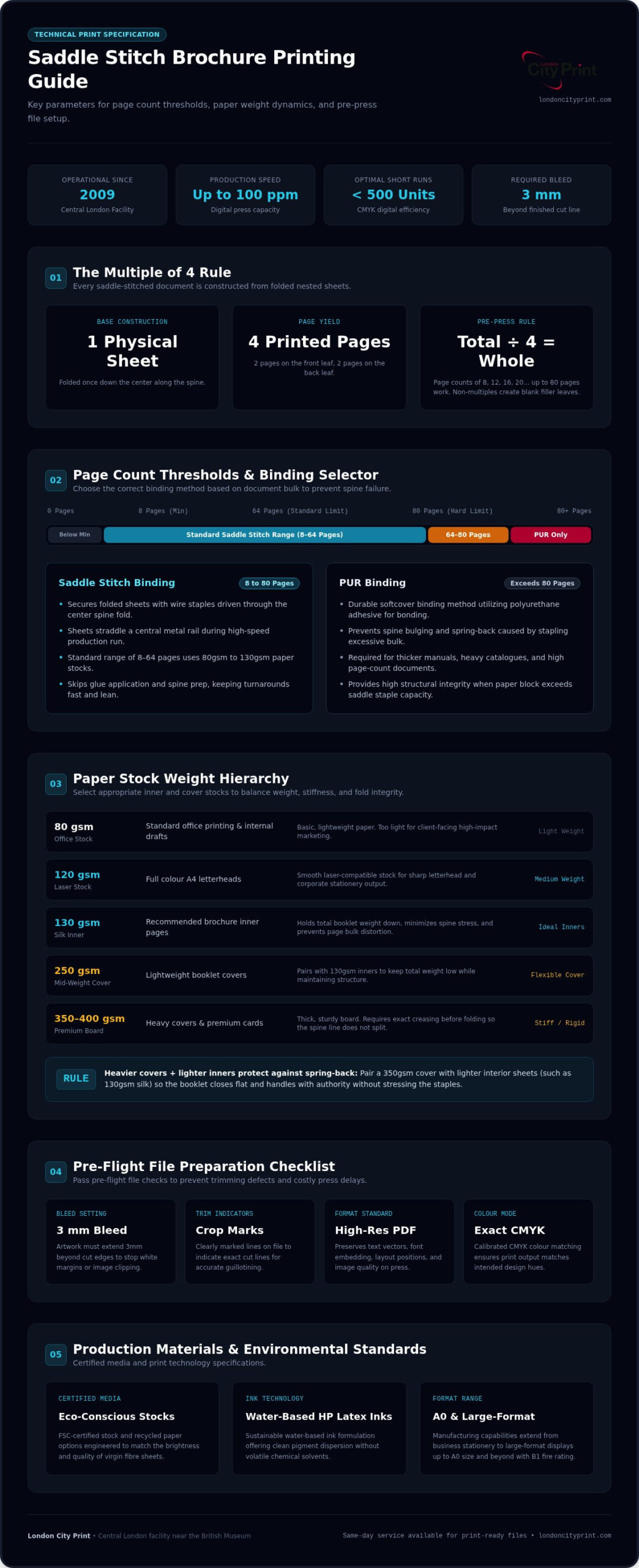
Key Takeaways: Saddle stitch brochure printing uses wire staples along the spine to secure 8 to 80 pages, provided the total count is a multiple of four.
- Standard page limits range from 8 to 64 pages using 80gsm to 130gsm paper stocks.
- Skip it when your document exceeds 80 pages because the spine will bulge and spring open.
- Choose a 350gsm cover with lighter inner pages to ensure the booklet handles professionally without cracking.
- London City Print provides same-day turnaround in Central London for projects that pass pre-flight file checks.
Match your booklet binding method to page count and deadline
Page count and turnaround pressure decide the spine long before you pick a paper stock. Three common situations show the pattern clearly:
- Small event programs, quick corporate updates, and sales flyers under 64 pages: use wire staples along the fold for a lean finish and fast turnaround.
- Thicker manuals with heavy page counts: switch to PUR binding, a durable softcover method that uses a polyurethane adhesive for a strong, flexible bond.
- Short runs under 500 units: digital printing delivers rapid turnarounds with precise CMYK colour matching and crisp finish quality.
Saddle stitching secures folded sheets with metal staples along the spine for slim, professional booklets. It fits those lighter documents without added bulk, keeps the layout clean, and limits paper distortion at the fold. Thicker manuals need the PUR route instead, because a stapled spine cannot carry that bulk.
For short runs under 500 units you still get precise CMYK matching on digital presses. You can order fast, reliable production from London City Print when an event date is fixed. Pre-flight file checks confirm your artwork carries correct crop marks and enough bleed before it goes to press.
Lightweight corporate hand-outs suit this finish because the fold stays crisp and production stays quick. Select your paper weights, upload your high-resolution PDFs, and ask for a personalized quote for your next marketing project.
How saddle stitch brochure printing secures lean, professional booklets
Saddle stitching fastens folded sheets along the spine using wire staples. Your document must be designed in multiples of four pages. A saddle-stitched range of 8–80 pages works well on standard paper weights.
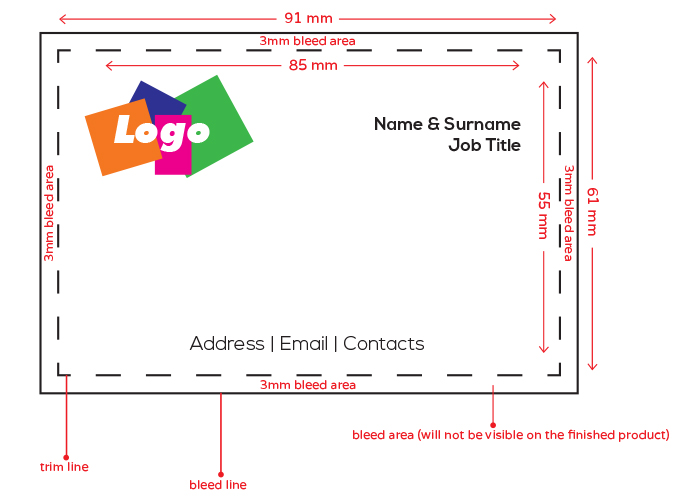
Thicker papers reduce the total page limit because heavy sheets create tension at the fold. To stop artwork clipping on outer edges, add a 3mm extra image area that extends past the final cut. Skip that setup and you risk incorrect dimensions and trimmed-off content on the finished edges.
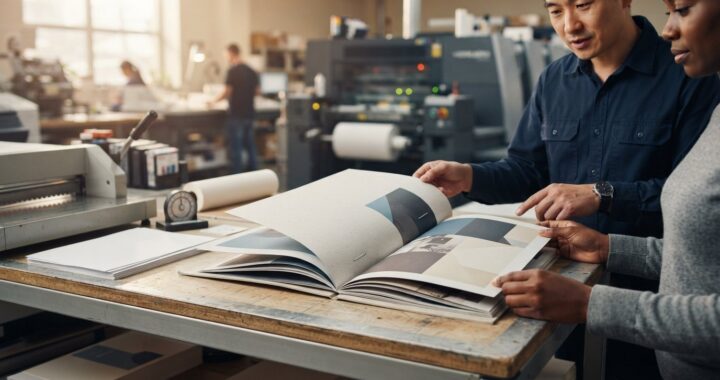
According to the Wikipedia Saddle Stitch Stapler (2026) reference entry, machine operators align sheets over a metal saddle or rail before driving wire staples through the center fold. The sheets straddle that central rail during high-speed production, which is how the method takes its name.
High-resolution PDFs go straight to output through advanced equipment at the Central London facility. For projects past 80 pages, a glued spine (perfect bound) gives better structural integrity. You can review the corporate brochure guide when you need fast turnarounds on business publications. Run pre-flight checks so the full file setup is clean before you submit.
Heavier covers and lighter inners protect your spine from spring-back
Paper stock choice hangs on total page count and how long the piece must last on a desk or in a bag. Pair a heavier 350gsm cover with lighter interior pages so the booklet handles well and still looks authoritative. Thick stock on every interior leaf of a high-page booklet causes spring-back and stresses the spine.
Standard office paper typically sits at 80gsm, which is too light for high-impact marketing. For business cards and brochure covers, premium boards from 350gsm to 400gsm give the stiffness you need. Light 80gsm sheets under a heavy cover feel underbuilt next to client-facing material.
| Stock Weight | Recommended Application | Output Characteristics |
|---|---|---|
| 80gsm | Standard office printing | Basic, lightweight paper |
| 120gsm | Full colour A4 letterheads | Smooth laser-compatible stock |
| 350gsm–400gsm | Premium cards and covers | Thick, sturdy board |
Thick cover stock needs exact creasing before folding so the spine line does not split. Beyond booklets, the team also handles large format displays that match your corporate branding. Standard office sheets fit quick internal drafts; 350gsm covers suit sales material you hand to clients. Pre?flight file checks verify crop marks and layout before production begins.
Tip: Select eco?conscious stocks when you want professional durability alongside modern environmental standards.
Why saddle stitch binding keeps booklet printing costs down
Saddle stitching keeps production cost low for thin booklets because it uses nested sheets folded and stapled along the spine.
That simple mechanism skips glue application and complex spine preparation. Standard glued-spine books need thick page blocks to hold adhesive, which raises material cost on low page counts. Folding sheets into 4-page sections keeps labour minimal.
Paper weight feeds straight into the final bill. Choosing 130gsm silk inner pages with a 250gsm cover holds total weight down and reduces shipping rates. Full bleed at 3mm on your high-resolution PDFs, plus clear crop marks in the file, prevents costly pre-press delay.
You do not need another supplier to mishandle an urgent order or miss an event date. Time-sensitive runs stay in the Central London facility, from general business stationery through to urgent conference exhibition work with delivery to your stand.
Can digital web tools simplify complex print configurations? Among Google reviews, one local client wrote:
"We are a local firm of property consultants and chartered surveyors and London City Print do a great job for us in quick time and very reasonable rates. I would definitely recommend. Paul Wise, Director, Hanway Commercial"
That arc is plain: a property consultancy needed dependable document output on a tight clock and a controlled budget, placed the work with the Central London team, and got fast turnaround at rates they were willing to recommend. Fast turnaround and clear pricing support commercial project documentation when the brief is similar.
A commenter in the printplanet.com thread "Forum list":
"Online editor component for print shops in 2026, any real use cases left?" (source)
Digital editing tools help with layout checks, yet dedicated pre-flight review by print experts still catches bleed and resolution errors before production.
Correct PDF setup prevents costly print failures on press
File mistakes put events and client commitments at risk, so treat PDF setup as part of the print job, not an afterthought.
- Convert colours to CMYK: Change your artwork from RGB to CMYK colour profile to guarantee accurate printing output.
- Set up bleed: Extend your background artwork 3mm past the final cut edge so trimmed edges show no white gaps.
- Embed all fonts: Export high-resolution PDFs with embedded fonts to keep your typography intact.
- Run pre-flight checks: Perform pre-flight file checks or use the file-checking service to catch resolution issues before production starts.
An error in the original file magnifies through every stage of production, the way a fault in a house frame shows up in the finished walls. For fast results in Central London, you can use same-day turnaround options when the schedule is tight.
Exact file processing means your brochures arrive ready for the audience. On a related press topic, a commenter in the printplanet.com thread "Forum list" asked:
"Why is UV ink not fully cured in flexo printing?" (source)
Uncured UV ink usually occurs when the UV lamp intensity is insufficient or when the ink layer is applied too thick for the light to penetrate completely. Check lamp wattage and ink film thickness to ensure a complete chemical cure.
When your page count or stock makes saddle stitching the wrong choice
Saddle stitching fails when your page count exceeds technical limits or the stock is too heavy for a stapled fold.
Past roughly 64 pages, the spine bulges and the booklet springs open rather than sitting calmly in the hand. Thick weights such as 300gsm make the problem worse and can crack along the fold line. For high-page documents, choose a glued spine or PUR binding so the artwork stays secure. PUR is the sound choice for thick books because polyurethane adhesive creates a strong, lay-flat hold that staples cannot match.
Forcing high page counts into wire staples also causes severe creep: inner pages push past the outer cover, and you lose text near the trimmed edges when the finished block is cut.
Wrong binding under deadline stress ruins the presentation you take to a meeting or a stand. If the page count is already high, move to PUR early rather than trying to force staples to do a job they cannot do.
Pre-flight file checks catch page-count errors before production begins. Contact the Central London team when you need rapid overnight printing delivered straight to your venue.
Frequently asked questions
How does saddle stitch binding work?
Saddle stitch binding secures folded sheets together along the spine using heavy-duty wire staples. Printed pages are aligned, folded down the center, and stapled through the crease to create a clean document.
How does saddle stitch binding provide cheap booklet printing?
The method removes the need for structural glues or complex mechanical assemblies during finishing. Fast production runs keep labour requirements low while still delivering professional quality for marketing materials.
How many pages can be printed in a saddle stitch booklet?
Saddle-stitched booklets hold between 8 and 80 pages. You must design the document in multiples of four pages because each folded sheet creates four distinct panel sides.
How much does booklet printing cost?
Overall costs depend on paper weight, total page count, production speed, and custom finishing options such as lamination. Submit your job specifications through the site to receive a personalized quote tailored to your print run.
What is saddle stitch binding?
Saddle stitch binding is a classic finishing method where folded paper sheets nest together and bind with metal staples along the spine. The result is a streamlined layout suited to slim booklets and event programs; for a document that must stay open flat on a desk, choose PUR or another lay-flat binding instead.
Send your files once binding, paper, and page count are set
Saddle stitch brochure printing delivers a clean, professional finish when your commercial document stays within the page and stock limits described above. You can rely on the Central London facility for rapid production once those choices are locked. In 2026 the team still provides same-day turnarounds alongside pre-flight file checks that verify CMYK colour profiles, bleed, and crop marks. Those reviews protect your schedule and remove costly layout errors before full production begins. Upload your high-resolution PDFs to hold the timeline, order through our professional booklet service, or contact the desk now for a custom quote.