
A single pixel of error or a misunderstood margin can transform high-stakes Booklets and Brochures into a costly logistical nightmare. You’ve likely felt that spike of adrenaline when the clock is ticking toward a major event and the physical product is still in production. Technical jargon like bleed and GSM shouldn’t be a source of confusion. It’s stressful to manage tight deadlines while worrying if your digital artwork will translate perfectly to the final printed page.
This guide helps you master the technical and strategic nuances of high-quality print to command immediate attention. You’ll learn how to navigate the production process with the confidence that your materials will meet every corporate deadline. We’ll explore expert specifications for professional finishing and explain how to leverage local expertise for same-day delivery in Central London. This ensures your brand always arrives on time and with a flawless finish that reflects your professional standards.
Key Takeaways
- Understand why physical Booklets and Brochures drive higher engagement and trust compared to digital alternatives in a corporate environment.
- Select the most appropriate binding method, such as Wire Binding for technical documents or Saddle Stitching for marketing materials, to ensure both durability and style.
- Eliminate costly production delays by mastering essential technical specifications like the 3mm bleed rule and CMYK color profiles.
- Learn how to choose the ideal paper weight (GSM) and finish to create a tactile experience that aligns with your brand’s professional identity.
- Leverage Central London’s rapid-turnaround capabilities to meet urgent event deadlines with same-day production and local courier delivery.
The Strategic Value of Professional Booklets and Brochures in 2026
Digital saturation has reached a tipping point where physical presence now signals true authority. In a corporate environment like Central London, a well-executed piece of print serves as a permanent record of your expertise. While digital files are easily deleted or forgotten, Booklets and Brochures demand attention through their physical tangibility. They provide a sensory experience that digital platforms lack, using weight and texture to convey a message of stability. A comprehensive overview of brochures highlights their role as a primary tool for informing a specific audience about products or services. In 2026, this role has evolved into a strategic asset for high-stakes business communication.
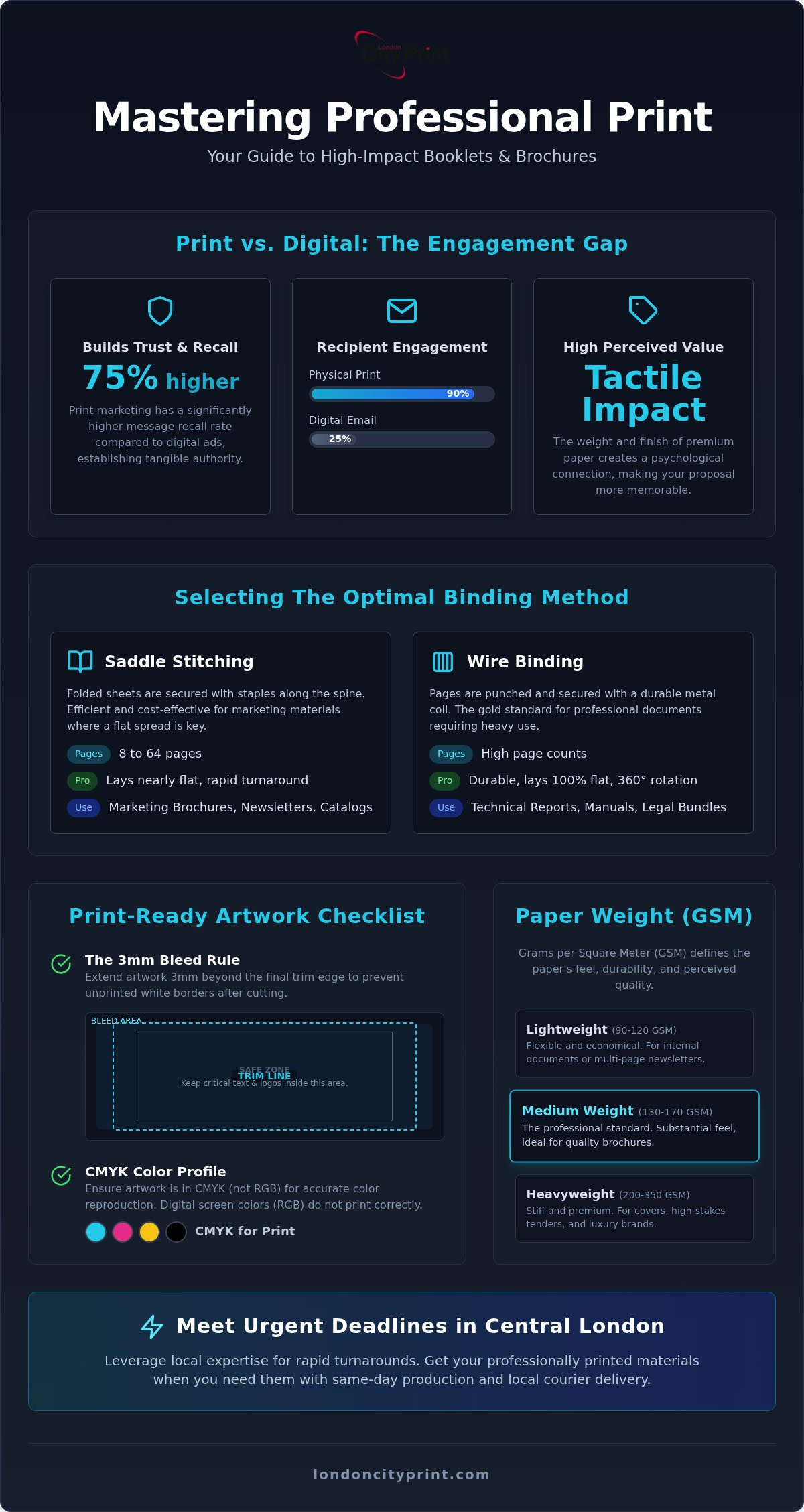
The effectiveness of print is backed by compelling data. Research shows that print marketing has a recall rate between 70% and 80% higher than digital advertising. While email open rates often struggle to exceed 20% to 30%, roughly 90% of physical print materials are opened by their recipients. For industries such as Finance, Legal, and Luxury Retail, these statistics represent a significant competitive advantage. These sectors rely on the “leave-behind” to maintain a presence in the room long after a meeting has concluded. High-quality print acts as a silent partner, reinforcing your brand’s reliability when you aren’t there to speak for it.
For brands in these sectors, ensuring that physical goods also reflect this level of quality is vital; you can discover Prest Packaging for specialist beverage and bespoke health packaging that maintains your brand’s authority at every customer touchpoint.
Marketing Collateral vs. Technical Documentation
Choosing the right format depends on your specific objective. Brochures typically serve as the frontline of your brand identity, designed to capture interest through bold visuals and concise messaging. They’re essential for product launches and high-level corporate introductions. Booklets, conversely, are the workhorses of information density. They’re necessary for technical manuals, legal bundles, and comprehensive reports where functionality is just as important as aesthetics. Balancing these two needs is crucial; your documentation must be easy to navigate while still looking professional enough to represent a premium service. For events and exhibitions where your printed collateral needs to work alongside large-scale displays, pairing your booklets with professionally produced large format poster printing in London ensures a cohesive and impactful brand presence across every touchpoint.
The ROI of Premium Print in High-Stakes Tenders
In the competitive atmosphere of the City, the physical presentation of a tender can be the deciding factor in securing a contract. A physical document builds trust in a way that a link to a cloud drive simply cannot. When a potential client feels the weight of a professionally bound report, they’re experiencing sensory marketing that suggests your firm is thorough and detail-oriented. This tactile impact creates a psychological connection with the reader, making your proposal more memorable. Investment in premium print is an investment in the perceived value of your entire business proposition.
Selecting the Optimal Binding: Form, Function, and Professionalism
The choice of binding is a technical decision that dictates the lifespan and usability of your printed materials. For professional Booklets and Brochures, the binding method should align with the document’s purpose, page count, and the environment where it will be used. A mismatch here can lead to pages falling out during a critical presentation or a document that won’t stay open when a user needs to refer to a technical manual. We treat binding as a structural element that reinforces the authority of your content.
Saddle Stitching for High-Impact Marketing
Saddle stitching is the most efficient and cost-effective method for documents between 8 and 64 pages. This process involves securing folded sheets together with metal staples along the spine. It’s particularly effective for marketing collateral and newsletters because it allows the document to lay nearly flat. This feature is vital when designing a brochure with large, impactful visual spreads that cross over the gutter. Because the production process is streamlined, it’s the preferred choice for rapid-turnaround projects that need to be delivered across London within hours.
Wire Binding for Professional Reports and Legal Bundles
When a document needs to withstand constant handling in high-pressure environments, wire binding is the gold standard. This method involves punching holes through the edge of the pages and threading a durable metal coil through them. It’s the indispensable choice for technical manuals and legal bundles because it allows for full 360-degree rotation. This means the document can be folded back on itself or laid perfectly flat on a desk without the spine cracking or pages turning themselves.
For documents that exceed the page limits of saddle stitching, wire binding provides a secure finish that suggests technical mastery. It’s frequently utilized for:
- Annual corporate reports and financial statements
- Complex legal bundles and court documents
- Technical training manuals and reference guides
- Premium event programmes for Central London conferences
If you’re aiming for a prestigious “book” feel, perfect binding offers a flat, printable spine using thermal adhesive. This is ideal for high-end property brochures or thick corporate catalogues that need to sit neatly on a bookshelf. If you are struggling to choose the right specification for your deadline, our team can help you select the most effective binding and finishing options for your specific project. Whether you are preparing wedding stationery or a high-stakes tender, the binding provides the structural integrity that ensures your Booklets and Brochures remain intact throughout their lifecycle.
Technical Specifications: Ensuring Your Artwork is Print-Ready
A flawless physical product starts long before the paper meets the press. For London businesses operating on tight schedules, technical errors in artwork are the primary cause of production delays. Understanding the mechanics of print design ensures that your Booklets and Brochures transition from digital files to professional documents without friction. This precision is vital because the neuroscience of print marketing suggests that readers form deep emotional connections with tangible materials. Any technical flaw, such as pixelated images or misaligned text, breaks that connection and undermines your brand’s authority.
Maintaining brand consistency requires a shift from the RGB color space used on screens to the CMYK model used in commercial printing. While RGB can display vibrant neons, CMYK provides the predictable, professional results necessary for corporate logos and high-end photography. Additionally, image resolution must be at least 300 DPI at the final print size. Lower resolutions result in a blurred appearance that contradicts the high-stakes nature of a City tender or a legal bundle. You must also account for the gutter margin, which is the space lost in the spine during binding. Without this adjustment, your content may disappear into the fold, especially in thicker wire-bound documents.
The 3mm Bleed and Quiet Zone Explained
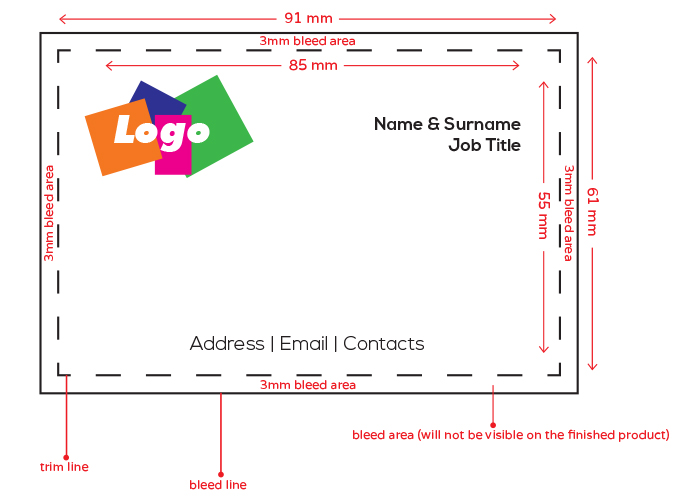
The 3mm bleed rule is the most critical specification for any professional print project. It involves extending your background colors or images 3mm beyond the final trim edge to ensure no white borders appear if the cutting blade shifts slightly. You should also maintain a “Quiet Zone” or internal margin of at least 5mm. This keeps essential text and logos away from the edge, preventing them from being cut off or lost in the binding. To set this up correctly:
- InDesign: Go to File > Document Setup and enter 3mm in the Bleed section.
- Canva: Select File > View Settings > Show print bleed before exporting your file.
Exporting for Success: PDF Standards for Commercial Print
Final export settings determine how our machinery interprets your design. We recommend using the PDF/X-1a standard because it’s designed specifically for reliable commercial output. This format automatically embeds all fonts and flattens transparency layers, which prevents unexpected layout shifts during the printing process. It’s a safeguard against the common errors that often plague automated online platforms. Print-Ready is the alignment of 3mm bleed, 300 DPI resolution, and a CMYK colour space within a standardized PDF file. Following these technical requirements allows us to guarantee the rapid turnaround your project demands. For a comprehensive overview of how these specifications fit into a broader production workflow, our commercial printing solutions London 2026 resource guide provides detailed guidance for corporate clients operating under tight deadlines.
Tactile Impact: Navigating Paper Weights and Premium Finishes
The physical weight of your Booklets and Brochures communicates your brand’s value before a single word is read. In the London corporate sector, where first impressions are often the only impressions, paper choice is a strategic decision rather than a mere technicality. GSM, or Grams per Square Metre, is the standard metric used to measure paper thickness and weight in the UK. Selecting the wrong weight can lead to a document that feels flimsy or, conversely, one that’s too rigid to handle comfortably. We view paper selection as the “handshake” of your printed communication.
Choosing the Right GSM for Your Project
For the inner pages of most professional documents, 130 to 170 GSM is the industry sweet spot. This weight provides enough opacity to prevent text “show-through” while remaining flexible enough for easy page-turning. When you move to the cover, a weight of 250 to 350 GSM is essential. This creates a robust exterior that protects the internal content and commands respect during a presentation. The tactile difference between a standard flyer and a premium cover is immediately apparent to the touch, reinforcing the perceived value of the information inside.
Finishing Touches: Lamination and Beyond
Lamination adds a thin layer of protective film to the paper, significantly increasing its durability and aesthetic appeal. Matt lamination is the preferred choice for a sophisticated, non-reflective finish that’s easy to read under harsh office lighting. It feels smooth and premium, making it a staple for high-end corporate brochures and technical reports. If your project relies on high-resolution photography or vibrant graphics, gloss lamination makes those colours pop with intensity and depth. This finish is particularly effective for luxury retail catalogues or property portfolios where visual impact is paramount.
For brands seeking a modern or “green” aesthetic, uncoated stocks offer a raw, tactile texture that’s increasingly popular in 2026. These stocks absorb more ink, resulting in a softer, more muted look that suggests authenticity and environmental responsibility. This choice is ideal for sustainability reports or boutique event programmes. Whether you require a high-gloss finish for a visual portfolio or a tactile uncoated stock for a modern brand identity, we can guide you through the selection process. You can explore our full range of paper and finishing options to find the perfect match for your specific corporate requirements. If your event or exhibition also calls for eye-catching displays to complement your printed materials, our guide to large format poster printing in London covers the technical and logistical considerations for achieving maximum visual impact at scale.
While focusing on the environmental impact of your brochures, it’s worth considering the sustainability of your broader workspace; you can check out Greenline Environmental for professional waste management and collection services that keep your London operations running cleanly.
Navigating Tight Deadlines with a Central London Printing Partner
In the high-stakes environment of Central London, time is often the most expensive commodity. When you’re managing a major project, the physical distance between your office and your printing partner can be the difference between a successful launch and a missed deadline. Choosing a local partner for your Booklets and Brochures provides a level of responsiveness that automated online platforms simply cannot match. We operate with a sense of urgency that mirrors the fast-paced nature of the City, ensuring that your professional reputation is never compromised by logistical delays.
Our Central London location allows us to offer a genuine same-day turnaround for urgent projects. Whether you’re hosting an exhibition near the British Museum or need premium materials delivered to a boardroom in the Square Mile, our local courier network ensures your products arrive within hours. Online-only printers often hide behind shipping networks and third-party logistics that can fail during peak periods. We maintain direct control over every stage of the production and delivery cycle, providing a dependable support system for corporate clients who are operating under intense pressure. Understanding the full landscape of commercial printing solutions London businesses rely on can help you make a more informed choice when selecting a production partner for time-critical work.
Meeting Corporate and Legal Deadlines
Legal and corporate environments operate under rigid timelines where “next-day” delivery is often too late. We specialize in the rapid production of legal bundles and court documents that require absolute precision and immediate action. Our team is equipped to handle last-minute changes to event programmes or technical documentation with the calm assurance of an authoritative expert. Reliability is our core service; we understand that being constantly available and highly responsive is what makes us an indispensable partner for London’s business community.
The London City Print Difference: Expert Oversight
The primary advantage of working with a local professional is the human-led oversight that catches errors before they hit the press. While many “cheap” online competitors rely on automated algorithms that often miss bleed or margin issues, our experts conduct manual artwork checks. This process ensures that the technical specifications we’ve discussed, such as 300 DPI resolution and CMYK colour consistency, are perfectly executed. You have the opportunity to speak directly to a technically skilled professional rather than navigating a generic chatbot or waiting for an email response from a distant call centre.
As an independent commercial printer, we take pride in acting as a silent but vital engine behind your most critical projects. We facilitate the success of your tenders and events by providing technical mastery and a genuine commitment to your deadlines. If you’re currently facing a high-pressure deadline and need a reliable partner to deliver a flawless physical product, contact our Central London team for an urgent quote today. We are ready to ensure your brand arrives on time and with the precision it deserves.
Mastering Your Professional Print Strategy
Success in the London business landscape requires a blend of technical precision and logistical speed. By mastering specifications like the 3mm bleed rule and selecting the optimal paper weight, you ensure your Booklets and Brochures arrive without error and make a lasting impact. The strategic choice of binding, whether it’s durable wire binding for a legal bundle or a lay-flat saddle stitch for a marketing brochure, provides the structural integrity your brand demands. These details transform simple documents into powerful tools for building trust and securing new contracts.
Our Central London team acts as your indispensable partner, providing expert technical support for complex corporate and legal print requirements. We offer rapid same-day turnaround and specialize in high-quality commercial finishing to meet even the most demanding event schedules. Don’t leave your physical brand presence to chance or automated systems that miss critical details. You can confidently move forward with your next project knowing our experts are overseeing every stage of production. Request a Professional Quote for Your Booklets and Brochures to start your next project today.
Frequently Asked Questions
What is the difference between a booklet and a brochure?
A brochure is typically a single sheet of paper that has been folded one or more times, such as a bifold or trifold layout. Booklets consist of multiple sheets that are bound together using staples, wire, or adhesive. While brochures are excellent for quick marketing snapshots, booklets are the preferred choice for high-density information like annual reports, technical manuals, and legal bundles.
Can you print and bind my booklets on the same day in London?
Yes, our Central London facility is specifically equipped to handle rapid turnaround requests for corporate clients. We manage the entire production process on-site, which allows us to print and bind Booklets and Brochures within hours to meet urgent event or court deadlines. This local oversight eliminates the shipping delays associated with out-of-town or online-only printers.
What is the best binding for a 50-page technical report?
Wire binding is the most functional and professional choice for a technical report of this length. It provides the durability needed for frequent handling and allows the document to lay perfectly flat on a desk. This 360-degree rotation is a critical feature for reports that users need to refer to while working, ensuring the spine doesn’t crack or lose pages over time.
How do I set up my file for a saddle-stitched booklet?
Your artwork should be supplied as a single PDF file with pages in chronological order rather than as pre-imposed spreads. It’s essential that your total page count is a multiple of four, as this binding method uses folded sheets of paper. You must also include a 3mm bleed on all edges and maintain a quiet zone for text to ensure no vital information is lost during the trimming process.
What is the minimum page count for perfect binding?
Perfect binding typically requires a minimum spine thickness of approximately 3mm, which usually equates to 40 to 50 pages depending on the GSM of the paper used. If your document is thinner than this, the adhesive may not provide a secure enough bond. For projects with lower page counts, we recommend saddle stitching as a more reliable and cost-effective structural alternative.
Do you offer courier delivery to offices in Central London?
We provide dedicated courier delivery services to all major business districts in Central London, including the City, Westminster, and the British Museum area. Once your project is finished, we can have it dispatched immediately to ensure it reaches your office or event venue within a few hours. This service is a core part of our commitment to supporting high-pressure corporate environments.
What paper weight (GSM) should I use for a professional brochure?
For a premium feel, we recommend using 150 GSM to 170 GSM for the internal pages and a heavier 250 GSM to 350 GSM for the cover. This combination ensures that the Booklets and Brochures have enough tactile weight to feel substantial without becoming too rigid to handle. Adding a matt or gloss lamination to the heavier cover stock further increases the durability and professional finish of the final product.