

A roller banner isn’t just a portable poster; it’s a piece of architectural branding that can either anchor your professional presence or signal a lack of technical preparation. You likely understand the pressure of preparing for a high-stakes London trade show where every detail reflects your brand’s authority. The fear of low-resolution graphics or critical information being swallowed by the base mechanism is a valid concern for any professional operating under tight deadlines. This roller banner design guide provides the technical clarity and creative framework required to master the 2000mm vertical canvas with absolute confidence.
We’ll bridge the gap between creative vision and print-ready reality by exploring the specific “safe zones” for standard 800mm and 850mm widths. You’ll learn how to structure a vertical hierarchy that commands attention and why material selection is vital for repeated transport across the city. This guide outlines the exact specifications for 2026 to ensure your design aligns with brand standards and avoids the frustration of costly reprints. From resolution requirements to mechanical bleed, we’re providing the roadmap to a flawless, high-impact display that functions as a silent engine for your event success.
Key Takeaways
- Prioritise the top third of your layout for logos and essential messaging to ensure maximum visibility above standing crowds at busy exhibitions.
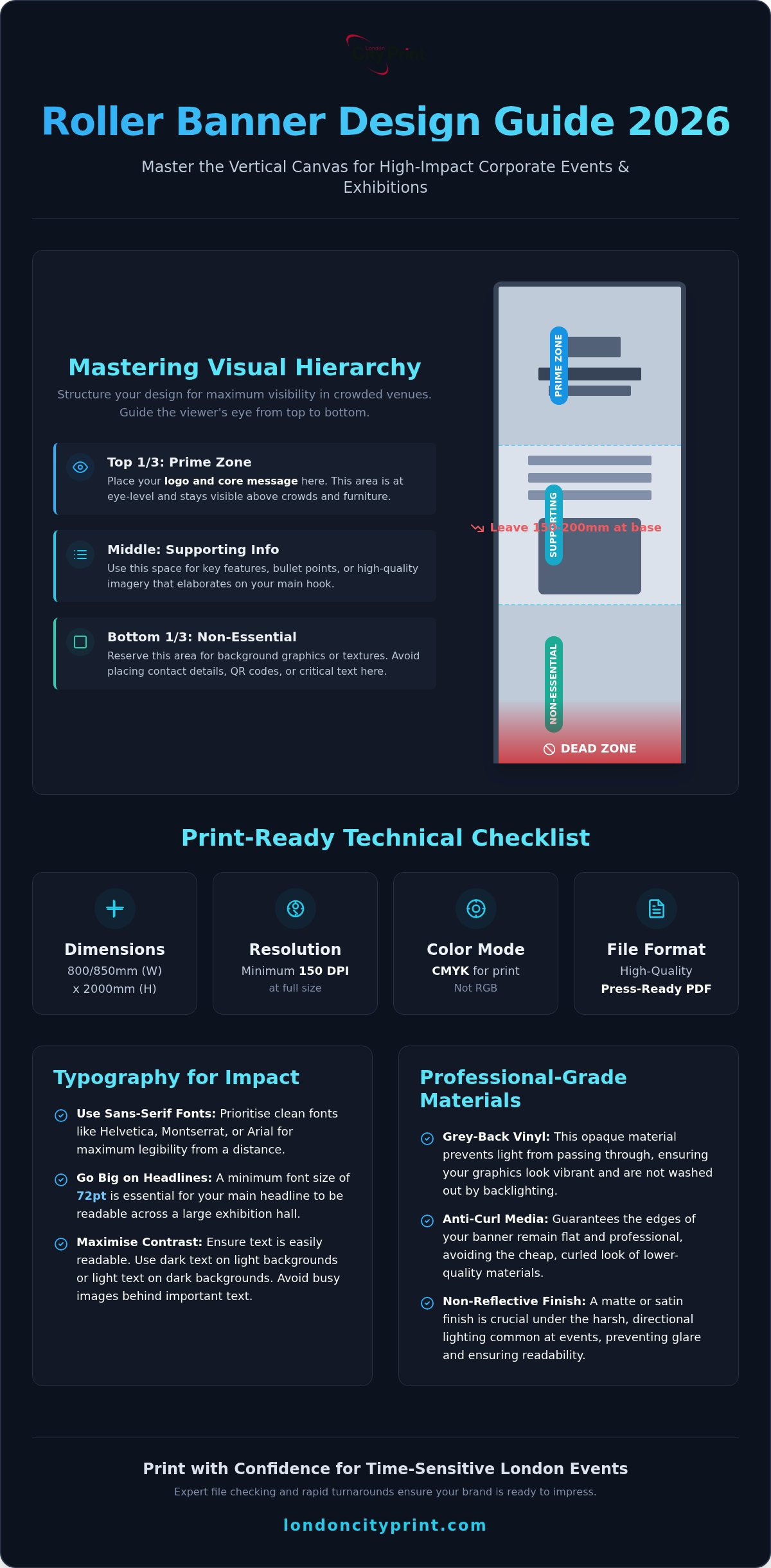
- Account for the “Bottom Dead Zone” by leaving 150mm-200mm of bleed at the base to prevent the roller mechanism from obscuring your design.
- Select professional-grade materials like grey-back vinyl and anti-curl media to maintain a premium, non-reflective finish under harsh event lighting.
- Follow this roller banner design guide to create print-ready files that meet the 2026 technical requirements for standard UK banner dimensions.
- Utilise expert file-checking services to eliminate technical errors and secure rapid turnaround times for time-sensitive London corporate events.
The Role of the Roller Banner in Professional Branding
A roller banner is a self-contained, portable display system engineered for high-impact vertical branding. In high-stakes corporate environments, these retractable displays serve as the primary anchor point for trade show booths and reception areas. They act as “silent salespeople” in high-traffic London venues like the ExCeL or Olympia, communicating brand authority without requiring immediate staff intervention. While digital marketing captures attention online, the physical presence of a well-executed banner builds tactile trust that screens simply cannot replicate in 2026. This roller banner design guide helps you bridge the gap between digital strategy and physical impact by ensuring your physical assets are as polished as your digital ones.
When to Use a Roller Banner vs. Fixed Signage
Fixed signage offers permanence, but the mobility of roller banners provides a distinct advantage for professionals operating under pressure. The lightweight aluminum bases and padded carry cases allow for effortless transport via the London Underground or rapid courier services. This makes them the preferred choice for tight exhibition schedules where speed is a priority. Their versatility extends across various corporate applications:
- Legal seminars and professional briefings.
- Retail pop-ups and product launches.
- Corporate lobbies and temporary reception areas.
From a financial perspective, roller banners offer a superior return on investment compared to permanent large-format installations. They’re easily stored and reused across multiple campaigns, provided the design remains evergreen and the hardware is professional-grade.
London Event Context: Designing for the ExCeL and Olympia
Securing a footprint at major venues like the ExCeL London or Olympia requires a design that commands attention from at least 20 metres away. In these expansive, crowded halls, your branding must pierce through the visual noise created by hundreds of competing displays. Rapid setup and teardown are critical requirements when exhibition slots are strictly timed and logistical windows are narrow. A professional roller banner allows your team to be fully “event-ready” in under 60 seconds. Following a technical roller banner design guide ensures that this speed doesn’t come at the cost of visual precision. To achieve a truly cohesive and authoritative presence, many professionals integrate these displays with large format poster printing London. This combination creates a comprehensive booth environment that dominates the floor and reinforces your brand’s reliability.
Mastering Visual Hierarchy: The Top-Down Strategy
Designing for a vertical canvas requires a fundamental shift in perspective compared to standard print media. Effective composition is primarily about Guiding the Viewer’s Eye from the most critical information down to supporting details. The “Golden Rule” of any roller banner design guide is that your primary message must live in the top third of the banner. In a crowded London exhibition hall, the lower portions of your display are frequently obscured by furniture, bags, or other attendees. If your core value proposition isn’t at the top, it doesn’t exist for the majority of your audience.
Your logo belongs at the very top. This placement ensures brand recognition from across the room, even in a packed venue. Just below the logo, at eye level, you must place your “Hook.” This is a concise, high-impact statement that captures attention in under three seconds. It’s vital to avoid the “Bottom-Third Trap.” Placing contact details or QR codes near the floor makes them invisible and physically difficult to access. Use the bottom section only for non-essential brand elements or background textures.
Typography for Large-Format Impact
Clarity is non-negotiable for large-format legibility. Prioritise clean, sans-serif fonts such as Helvetica or Montserrat, as these maintain their integrity from a distance. For your primary headline, a minimum font size of 72pt is necessary to ensure it’s readable across a large hall. Anything smaller risks being overlooked. Readability also depends on contrast; avoid the common error of placing light text over busy background images. High-contrast combinations, like dark text on a light background, remain the standard for professional reliability.
Strategic Call-to-Action (CTA) Placement
In 2026, QR codes serve as the essential bridge between your physical presence and your digital lead magnets. Position these in the middle third of the banner to ensure they’re easy to scan without requiring the prospect to bend down. Keep your CTA focused on a single action. Whether it’s “Scan for Case Studies” or “Visit Our Stand,” a singular focus is more effective for passing foot traffic than a cluttered list of options. For a seamless brand experience, ensure your banner’s design and CTA align with your business card printing London. This consistency reinforces your authority. If you need a final check of your layout before production, the experts at London City Print can review your files to ensure your hierarchy is optimised for the event floor.
Technical Specifications: Avoiding the Dead Zones
Technical mastery distinguishes a professional display from an amateur one. This roller banner design guide focuses on the mechanical constraints of the hardware to ensure your vision translates perfectly to the final product. Every retractable system has “dead zones” where the material is either gripped by the top rail or housed within the base mechanism. Ignoring these zones leads to obscured logos and cut-off text, which undermines your brand’s authority at high-stakes events.
The “Safe Zone” is the area of your design guaranteed to be visible once the banner is fully tensioned. For a standard UK 850mm x 2000mm canvas, you must account for a 10mm “Top Dead Zone” where the header bar grips the vinyl. More critically, the “Bottom Dead Zone” requires an additional 150mm-200mm of bleed at the base. This material stays inside the roller mechanism to provide the necessary tension. If you place essential information in this lower section, it will remain hidden inside the base unit. Always keep your primary content within the central 1800mm of the vertical span to ensure total visibility.
Resolution and Image Quality
A common misconception in large-format printing is the “300 DPI myth.” While high resolution is vital for small items like business cards, 100-150 DPI at full size is the technical sweet spot for roller banners. This provides crisp visuals at standard viewing distances without creating unmanageable file sizes. To maintain absolute precision, always use vector files such as .EPS or .AI for your corporate logos. Scaling a web-sized 72 DPI image to a two-metre height will inevitably result in a soft or blurry print that fails to reflect professional standards. High-resolution raster images should be reserved for background photography where subtle textures are required.
Color Modes and Bleed Requirements
Consistency across your branding materials requires strict adherence to CMYK color modes. Designing in RGB often leads to disappointing color shifts when the file is converted for vinyl production. To ensure a flawless finish, apply a 3mm bleed to the left and right edges of your document. This prevents thin white “cracks” from appearing at the edges during the trimming process. Finally, ensure all transparencies are flattened before exporting your final PDF. This step is a technical necessity to avoid “ghosting” or artifacts around your graphics during the printing process. Following these specifications ensures your roller banner design guide leads to a print-ready file that our team can produce with precision and speed.
Materials and Durability: Choosing Professional Grade
The physical substrate you select dictates how your brand is perceived under the high-intensity lighting of a professional venue. While the visual hierarchy is vital, the material quality is what maintains that impact throughout a multi-day event. This roller banner design guide prioritises durability to ensure your investment survives the logistical pressures of the London circuit. Choosing the right media prevents common failures like light bleed, curling edges, or mechanical instability that can undermine a corporate presentation.
Grey-back vinyl is the definitive industry standard for professional environments. Unlike standard materials, it features an opaque backing that prevents light from “shining through” the banner when positioned in front of windows or bright exhibition stands. This ensures your colours remain vibrant and your text remains legible regardless of the ambient lighting. To maintain a polished look, we utilise anti-curl media. This specialised material is engineered to stay perfectly flat even after months of storage, eliminating the “curled ears” look associated with budget alternatives. We also apply scratch-resistant finishes to the print surface, providing a vital layer of protection against the inevitable scuffs of transit and frequent assembly.
The aluminum base functions as the engine of your display. While budget stands are tempting for one-off use, they often lack the internal tension required for a perfectly vertical display. Professional-grade units use heavier, reinforced aluminum that provides a stable footprint in high-traffic areas. These bases are designed for longevity, allowing you to deploy your branding repeatedly without the mechanism failing or the stand leaning forward.
Sustainability in 2026 Print
Sustainability is a mandatory requirement for corporate procurement in 2026. Many London businesses now operate under strict ESG (Environmental, Social, and Governance) mandates that favour PVC-free alternatives. We offer recyclable polypropylene media that provides the same high-resolution finish as traditional vinyl without the environmental cost. Another sustainable strategy involves using interchangeable graphics. By reusing a high-quality aluminum base and simply updating the printed insert, you reduce material waste and lower your long-term marketing costs. All our production chains follow FSC-certified standards to support eco-conscious London enterprises.
Weight and Portability Considerations
Logistics in Central London require a balance between durability and portability. The “Tube Test” is a practical benchmark we use: your banner must be light enough for a single person to carry comfortably on the London Underground. Professional units achieve this by using high-grade, lightweight alloys. Every banner should be housed in a padded carry case. This is a non-negotiable requirement for protecting the roller mechanism and the printed media during courier transit or storage. To complement your vertical display, consider coordinating your messaging with Professional Booklets and Brochures for a cohesive and portable marketing presence. View our range of durable Roller Banners to secure a display that withstands the rigours of the London event circuit.
The London City Print Advantage: Speed and Precision
The final stage of this roller banner design guide isn’t about pixels or margins; it’s about production reliability. In a city where event schedules are non-negotiable, the gap between a finished design and a physical display must be bridged with absolute precision. We specialise in same-day and next-day turnaround times, providing a critical solution for the last-minute panic that often precedes major exhibitions. While global providers might offer three-to-five-day shipping windows, those timelines are incompatible with the fast-paced requirements of the London corporate sector. We’re here to ensure your project stays on track, regardless of how tight the deadline feels.
Our “Indispensable Professional Partner” approach begins with expert file checking. We don’t just hit print. Our production team reviews your artwork for the technical pitfalls discussed in previous sections, such as dead zone clearance, image resolution, and CMYK colour profiles. Catching a low-resolution logo or a missing bleed area before the ink hits the vinyl prevents costly reprints and ensures your brand maintains its professional decorum. This methodical thoroughness is why busy professionals rely on us as a silent engine behind their most important presentations.
Strategically located in Central London, we offer a level of accessibility that remote competitors cannot match. You can opt for rapid collection or take advantage of our local courier network for direct delivery to venues like the ExCeL, Olympia, or your corporate headquarters. This proximity reduces transit risks and allows for a final quality check in person if your schedule permits. Our presence in the heart of the city means we understand the logistical needs of modern commerce and can react with the speed your business demands.
High-Stakes Corporate Reliability
Legal and financial firms frequently operate under intense pressure, requiring event branding that matches their own standards of precision. These high-stakes clients trust us because we deliver quality-checked products that are ready for immediate deployment. The peace of mind that comes from a locally-produced banner is invaluable when you’re preparing for a high-profile briefing or a cross-border seminar. We take pride in being constantly available and highly responsive to these demanding requirements.
We provide bespoke consultations to help you navigate the specific requirements of your event. Whether you’re deciding between a standard 850mm width or a wider 1200mm impact display, our team offers technical mastery to guide your choice. We ensure the materials selected, from grey-back vinyl to recyclable polypropylene, align with your brand’s ESG mandates and visual standards. Using this roller banner design guide alongside our production expertise ensures your display is flawless from the first reveal. Contact London City Print today for a quote on your next project and experience a service designed for the speed of modern commerce.
Secure Your Professional Presence at Your Next London Event
Mastering the vertical layout and respecting mechanical dead zones ensures your brand commands attention without technical distractions. This roller banner design guide has provided the technical framework to transition from a digital concept to a high-impact physical asset. By prioritising visual hierarchy and selecting professional-grade materials like grey-back vinyl, you eliminate the risk of blurry graphics or hidden logos that undermine corporate authority.
Since 2009, we’ve acted as a silent engine for high-stakes event printing, offering an expert technical file review with every order to catch errors before production. Our Central London location ensures you have access to rapid turnaround times when deadlines are tight. Order Your Professional Roller Banner from London City Print and move forward with the calm assurance that your display is in expert hands. We’re ready to help you make a lasting impression on the exhibition floor.
Frequently Asked Questions
What is the standard size for a roller banner in the UK?
The standard UK roller banner size is 800mm or 850mm wide by 2000mm high. While larger widths like 1000mm or 1200mm are available for high-impact displays, the 850mm x 2000mm canvas remains the industry benchmark for trade show booths. This specific size offers the ideal balance between visual presence and portability for London venues. We recommend designing your artwork to these exact dimensions to ensure full compatibility with professional-grade aluminum bases.
How much bleed do I need for a roller banner design?
You need a 3mm bleed on the left and right edges and a significant bottom bleed of 150mm to 200mm. This roller banner design guide emphasises the bottom bleed because this section of the vinyl remains inside the roller mechanism once the banner is tensioned. Without this extra material, your design might not fully extend or could reveal the white edge of the vinyl at the base. Top bleed is generally not required beyond the 10mm header bar allowance.
What is the “safe zone” on a pull-up banner?
The safe zone is the central area of your design that is guaranteed to be visible once the banner is fully deployed. This typically excludes the top 10mm gripped by the header bar and the bottom 150mm to 200mm housed in the base. To maintain professional decorum, keep all logos, text, and QR codes at least 50mm away from these edges. This ensures your branding remains clear and unobstructed by the hardware or surrounding floor traffic.
Can I change the graphic in my existing roller banner stand?
It is technically possible to change the graphics in an existing stand, though it requires precision to avoid damaging the internal tension spring. For high-stakes events, we often recommend purchasing a complete new unit to ensure mechanical reliability. However, high-quality professional stands are designed for interchangeable graphics, allowing you to update your messaging while reusing the aluminum base. This approach supports sustainability mandates by reducing material waste and lowering long-term marketing costs.
What is the best resolution for large-format banner printing?
The optimal resolution for large-format banner printing is 100 to 150 DPI at the final output size. While 300 DPI is the standard for small items like business cards, such high resolution is unnecessary for banners viewed from a distance and results in unmanageably large files. Always ensure your logos are in vector format such as .AI or .EPS to prevent pixelation. High-resolution raster images should be used for background photography to maintain a polished and authoritative brand image.
What is grey-back vinyl and why is it used for banners?
Grey-back vinyl is a specialised print media with an opaque backing designed to block light from shining through the banner. In bright exhibition halls or when placed in front of windows, standard vinyl can appear semi-transparent, making your design look washed out. The grey layer ensures your corporate colours remain vibrant and your messaging stays legible under any lighting conditions. It is the industry standard for professionals who require unwavering visual consistency across all event environments.
How do I transport a roller banner across London safely?
You should always transport your roller banner inside its dedicated padded carry case to protect the aluminum mechanism and the printed media. When moving across London, keep the banner horizontal to prevent the internal spring from shifting and avoid placing heavy items on top of the case. The lightweight construction of our professional stands makes them easy to carry on the London Underground. This ensures you can arrive at your venue ready for a rapid and stress-free setup.
Can London City Print provide same-day roller banner printing?
London City Print provides a same-day roller banner printing service for clients operating under tight exhibition deadlines. Our Central London location allows for rapid collection or local courier delivery to major venues like the ExCeL or Olympia. By following a comprehensive roller banner design guide and submitting print-ready files, you can secure a high-quality display in hours rather than days. This responsive service is designed to solve the last-minute logistical challenges of modern corporate commerce.