
In a city where hospitality investment reached £2.0 billion in the first half of 2026, a stained or frayed menu isn’t just a minor oversight; it’s a direct threat to your brand’s perceived value. Most Central London operators know the frustration of menus that lose their premium feel after just one busy weekend shift or missing a crucial seasonal launch because of a slow print cycle. Securing reliable menu printing services London is essential for venues that need materials to work as hard as their front-of-house team while keeping pace with rapid menu changes and evolving allergen regulations.
This guide provides a professional checklist to ensure your menus reflect the high standards of the capital’s dining scene through superior durability and expert finishing. You will learn how to secure the fast turnarounds necessary for seasonal updates without sacrificing color accuracy or tactile quality. We will examine essential paper weights, wipe-clean laminates, and the logistical advantages of local production to help your venue meet 2026’s strict regulatory and aesthetic demands. From Natasha’s Law compliance to Extended Producer Responsibility for packaging, we’ve organized everything you need to maintain a competitive edge.
Key Takeaways
- Understand why premium physical menus remain the primary tactile brand touchpoint in 2026, effectively supplementing digital systems to enhance guest perception.
- Identify the optimal paper weights and lamination finishes, such as soft-touch and matt, required to create durable, wipe-clean menus for high-traffic venues.
- Master design techniques for longevity, including the use of safe-zone margins and CMYK color management to ensure food photography remains appetizing.
- Navigate high-stakes deadlines by utilizing professional menu printing services London for the rapid, same-day turnarounds essential for Central London hospitality.
- Establish a structured production calendar to manage seasonal menu transitions and ensure all printed materials meet the latest regulatory standards.
The Role of Professional Menu Printing in London’s 2026 Hospitality Sector
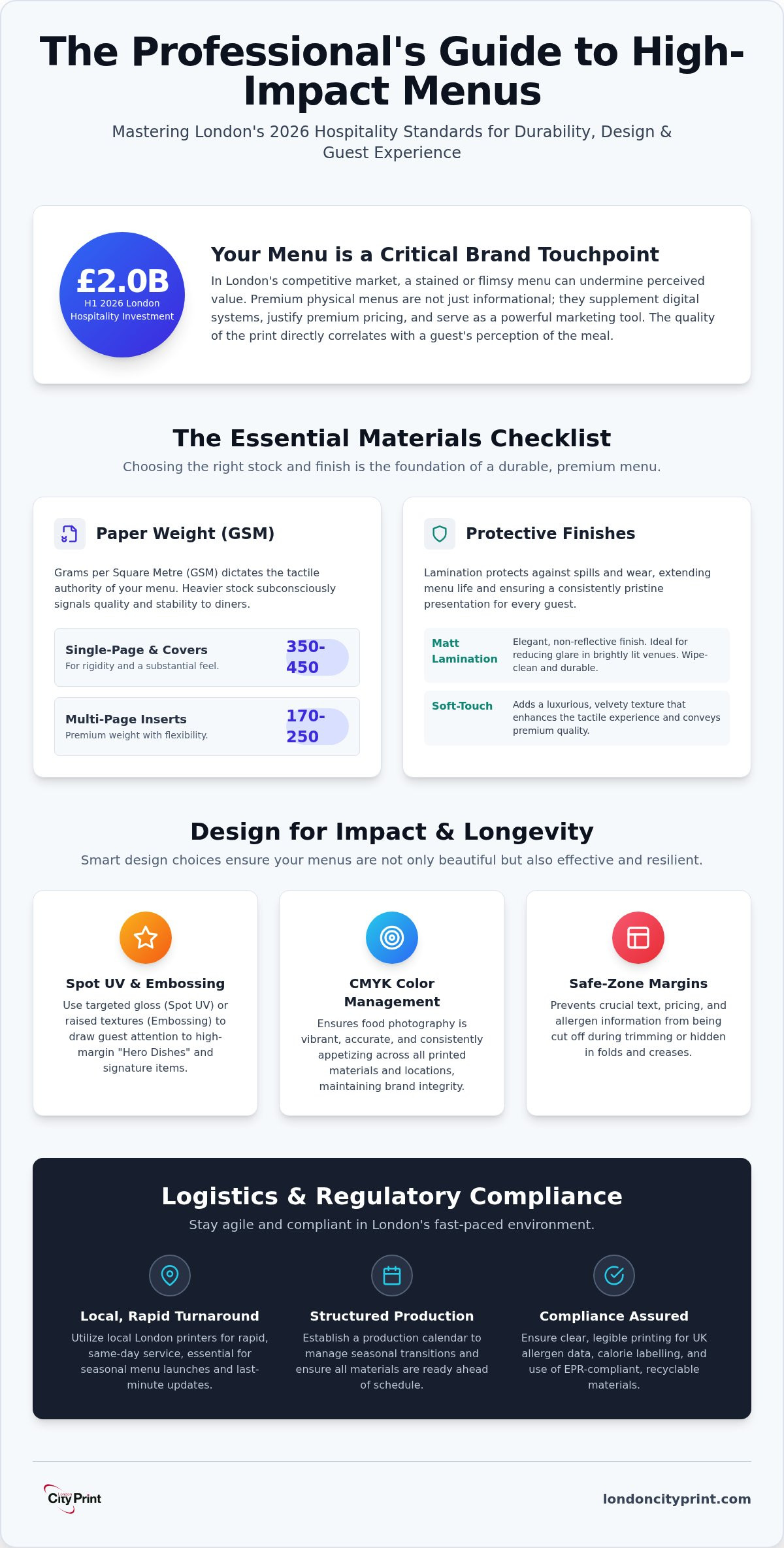
In the competitive landscape of Central London hospitality, the menu serves as the primary tactile interaction between a guest and your brand. While digital solutions offer convenience, the 2026 market has seen a distinct shift where premium physical menus supplement QR codes to meet the “London Standard.” This standard is defined by an international clientele that expects every detail, from the ambient lighting to the paper in their hands, to reflect a high level of sophistication. Utilizing professional menu printing services London ensures that your physical collateral reinforces your brand’s authority and justifies premium pricing. There is a direct correlation between the quality of the print and the guest’s perceived value of the meal; poor reproduction or flimsy materials make even the most artisanal food look unappealing and overpriced.
Beyond Information: The Menu as a Marketing Tool
A menu is more than a list of prices; it is a critical marketing tool designed to influence guest behavior. By applying Menu engineering principles, venues can use specific print finishes to highlight high-margin “hero” dishes. The psychology of paper weight plays a vital role here. Heavier stock, typically 300gsm or above, subconsciously suggests quality and stability to the diner. For multi-site London restaurant groups, maintaining this consistency across all locations is non-negotiable for brand integrity. Professional production ensures that a guest receives the same premium experience in Mayfair as they do in Shoreditch.
- Hero Dishes: Use spot UV or subtle embossing to draw the eye toward signature items.
- Paper Weight: Select 350gsm to 400gsm for a substantial, luxury feel that survives a full service.
- Consistency: Centralized print management prevents color variance across different restaurant sites.
The Shift Back to Tactile Dining Experiences
Digital fatigue is a documented trend in 2026. Diners are increasingly seeking the “theatre” of London fine dining, which includes the ceremonial presentation of a physical menu. This return to tactile experiences doesn’t ignore modern responsibilities. Under the 2026 Extended Producer Responsibility (EPR) regulations, London venues are prioritizing stocks that are both durable and fully recyclable. You don’t have to choose between a premium feel and environmental compliance. Professional menu printing services London provide access to advanced substrates that withstand the rigors of a busy service while meeting lifecycle requirements. High-quality lamination and finishing allow menus to remain pristine for longer, reducing waste and ensuring your brand presentation never falters during a high-stakes dinner service. Clear, well-printed allergen information is now a legal necessity, and professional print ensures this technical data remains legible throughout the menu’s lifespan.
The Essential Menu Specification Checklist: Materials and Finishes
Selecting the correct specifications is the difference between a menu that lasts a season and one that requires replacement after a single busy weekend. Professional menu printing services London provide technical options that balance aesthetic appeal with the high-stakes durability required in Central London venues. When every touchpoint reflects your brand’s quality, using a structured checklist ensures you don’t overlook the technical details that impact both guest experience and operational costs.
Selecting the Right Paper Stock (GSM)
Paper weight, measured in Grams per Square Metre (GSM), dictates the tactile authority of your menu. Single-sheet food and wine lists require a substantial stock between 350gsm and 450gsm to maintain rigidity without a holder. For the inner pages of multi-page bound menus, a range from 170gsm to 250gsm is standard; this provides enough weight to feel premium while remaining flexible for easy page-turning. Legibility is also a factor of stock choice. Uncoated stocks are often preferred in venues with high-intensity spotlights to reduce glare, ensuring guests can easily read the UK government’s menu regulations regarding calorie information and allergen data.
Protective Finishes and Lamination
Lamination is essential for hygiene and longevity in the 2026 hospitality landscape. Matt lamination remains the sophisticated choice for low-glare environments, while soft-touch finishes offer a premium, velvet-like feel that guests notice immediately. For high-turnover bars or outdoor terraces, synthetic paper is an “indestructible” option that is completely waterproof and tear-resistant. If your menus face heavy cleaning, encapsulation provides a sealed edge for total protection against spills. We also recommend specifying rounded corners; this simple finishing detail prevents “dog-earing” and keeps your menus looking pristine for significantly longer.
Binding Styles for Multi-Page Menus
The binding method you choose should reflect the “theatre” of your service. Wire binding is a functional, durable choice for drink menus because it allows the pages to lay perfectly flat on the bar or table. Saddle stitching, which involves stapling along the spine, is a lightweight and cost-effective solution for seasonal brochures or lunch specials. For more technical details on these methods, you can view our comprehensive guide on professional document binding London. If you aren’t sure which finish suits your venue, the experts at London City Print can provide physical samples to help you decide.
- 350gsm+ : Best for premium, stand-alone cards.
- Anti-bacterial Lamination: The modern standard for 2026 hygiene.
- Synthetic Stock: Ideal for wet environments and heavy handling.
- Rounded Corners: A vital finishing touch to prevent visible wear.
Design and Layout Considerations for Maximum Durability
Maximum durability begins long before the paper meets the press; it starts during the file preparation stage. When engaging menu printing services London, your design must account for the physical stresses of a high-turnover hospitality environment. This involves more than just aesthetics. It requires a technical understanding of how ink interacts with substrates and how margins protect your content from the inevitable wear of a busy service. A menu that looks beautiful on a screen can fail in the hands of a diner if the layout doesn’t respect the practicalities of commercial production.
Technical File Preparation for Menus
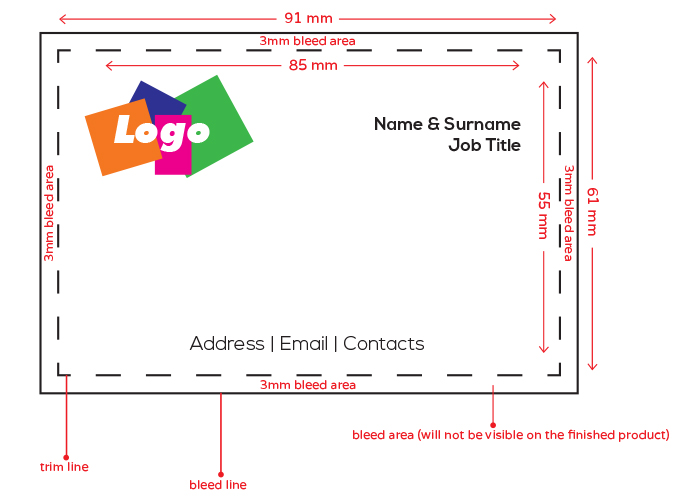
To ensure a professional finish, every design file must include a 3mm bleed. This extra margin of design prevents unsightly white edges from appearing after the trimming process. High-resolution imagery is equally critical for a premium result. All food photography should be at least 300dpi to maintain clarity at a close reading distance; anything lower will appear pixelated and unappetizing. Converting RGB brand colours to CMYK is also mandatory for accurate reproduction. Digital screens often display vibrant tones that are impossible to replicate in print without careful management, particularly with warm “food-safe” tones that can turn muddy if not correctly profiled during the design phase.
Adapting to Lighting and Environment
The physical environment of your venue should dictate your typography and finish choices. In dimly lit London bistros or basement bars, legibility is a common pain point for guests. We recommend high-contrast text and a minimum font size of 10pt for body copy to ensure your offerings remain readable under low-light conditions. Layouts should utilize generous white space to prevent visual clutter, which helps guests navigate the menu quickly and improves the overall user experience.
Regarding finishes, avoid high-gloss lamination in bright, window-heavy retail spaces because the glare can make text unreadable at certain angles. Instead, consider how your interior collateral works with your external branding. Many successful venues use custom vinyl window graphics to mirror the typography and style found on their menus, creating a cohesive brand journey from the street to the table. This consistency reinforces brand authority before the guest even sits down.
The “Safe Zone” and Structural Integrity
Designing for the “Safe Zone” means keeping all critical text and logos at least 5mm away from folds and edges. This ensures that even if a menu edge begins to show slight wear after weeks of heavy use, your pricing and descriptions remain perfectly intact and legible. By combining these design principles with professional menu printing services London, you create a product that maintains its premium feel throughout a demanding seasonal cycle.
- 3mm Bleed: Essential for edge-to-edge colour without white borders.
- 300dpi Imagery: The minimum standard for professional food photography.
- CMYK Conversion: Necessary to ensure brand colours match the intended palette.
- White Space: Improves legibility and reduces the cognitive load on the diner.
Logistics and Turnaround: Managing High-Stakes Deadlines
In a city where hospitality transaction volumes reached £2.7 billion in the first half of 2026, the pressure to maintain operational continuity is immense. A missed deadline for a seasonal menu launch or a late-night pricing error can disrupt an entire service and impact your bottom line. Professional menu printing services London must operate with the same urgency as the kitchens they serve. Having a local partner in Central London isn’t just about convenience; it’s about having a fail-safe system for the “same-day” reality that modern commerce demands. We understand that in the West End and the City, a print delay is not an option when guests are arriving in hours.
Streamlining the Print Approval Process
Speed shouldn’t compromise accuracy. To ensure a rapid turnaround without the risk of reprints, we recommend a structured approval workflow. This system is designed for busy professionals who need to move from design to delivery with minimal friction.
- Step 1: Finalise all copy and proofread specifically for price errors and allergen compliance.
- Step 2: Export your design to a Print-Ready PDF, ensuring the 3mm bleed and crop marks mentioned in our design guide are included.
- Step 3: Request a digital proof for immediate review or a physical proof for final colour sign-off if your schedule allows.
This methodical approach ensures that even the most complex booklets or multi-page menus are produced correctly the first time. It allows you to manage seasonal menu changes by setting a production calendar that accounts for both creativity and technical precision.
London-Specific Logistics
Navigating the logistics of the City and West End requires a partner who understands the unique challenges of Central London. We utilise rapid courier services specifically for venues in high-density areas where traditional delivery windows are often unreliable due to traffic. For ultra-tight deadlines, such as a tonight’s dinner service, the option to collect in person from a Central London facility is often the most dependable choice.
Planning for high-volume periods is also essential. Events like London Fashion Week or the Christmas season see a massive surge in demand for print. We recommend booking your production slots well in advance during these peaks. However, we pride ourselves on being an indispensable professional partner, remaining available for those last-minute corrections that inevitably occur under pressure. If you are facing a critical deadline for your venue, contact London City Print to discuss our rapid turnaround capabilities and secure your delivery slot.
Bespoke Menu Solutions from London City Print
London City Print understands the unique pressures of the capital’s hospitality sector. We don’t just provide print; we act as a silent but vital engine behind the scenes for venues that cannot afford downtime. Our facility is geared toward rapid, high-quality commercial production, ensuring your menus meet the uncompromising standards of 2026. This commitment to technical excellence makes us a preferred choice for menu printing services London. Whether you’re an independent bistro or a large-scale corporate hospitality provider, we offer the technical mastery required to translate your brand’s vision into durable, physical collateral.
Our expertise in producing Booklets and Brochures is directly applied to our menu production. This is particularly beneficial for multi-page wine lists or comprehensive seasonal brochures that require precise wire binding or saddle stitching. You gain direct access to technical experts who understand “London speed” and the logistical nuances of the West End and the City. We don’t believe in generic solutions; we provide tailored advice on paper weights and finishes that suit your specific venue lighting and turnover rates.
Why Central London Businesses Choose Us
London venues operate in a high-stakes environment where precision reprographics are mandatory. We focus on high-end finishing that protects your investment from the daily rigors of a busy restaurant. As a local specialist, we provide the calm assurance that even the most complex projects will be delivered on time. For a broader look at how we support the capital’s economy, explore our guide on the professional printing services London business landscape.
Get Started with Your Menu Project
We provide a streamlined path from design to delivery. You can supply your own print-ready files or consult with our team on technical specifications like paper weights and lamination types. We accommodate bespoke sizes and custom finishes that aren’t available through generic online platforms. Our goal is to ensure your menus remain pristine and professional throughout their entire lifecycle.
- Bespoke Sizes: We print beyond standard A4/A5 formats to suit your unique table settings and branding.
- Technical Consultation: Speak directly with a print expert about durability, GSM, and “food-safe” colour management.
- Immediate Assistance: Our Central London studio is positioned to handle urgent requests for tonight’s service.
Contact our Central London studio today to request a quote for your bespoke sizes and finishes. Whether you need a small run for a private event or a large-scale rollout for a multi-site group, we’re ready to provide the professional support your project demands.
Elevating Your Venue’s Brand Standards for 2026
The physical menu remains the most significant tactile touchpoint between your brand and your guests. By prioritizing high-grade paper stocks, durable laminations, and technical design precision, you ensure your collateral withstands the demands of a high-volume service while maintaining a premium feel. Success in the capital’s competitive market depends on balancing these aesthetic standards with the logistical reality of rapid seasonal updates. Accessing reliable menu printing services London allows you to meet these challenges without compromising on quality or missing critical launch deadlines.
London City Print has served as an independent Central London printer since 2009. We provide the expert technical advice and same-day turnaround capabilities necessary for high-stakes hospitality projects. We’re your dependable support system, ensuring every booklet, brochure, or single-sheet card reflects the professional excellence your guests expect. We invite you to Contact London City Print for a Bespoke Menu Quote and experience the assurance of a partner committed to your project’s success. Your next service deserves the precision that only a local specialist can provide.
Frequently Asked Questions
How long does professional menu printing take in London?
Professional menu printing typically ranges from same-day turnaround to 48 hours depending on the complexity of your requirements. Simple single-sheet cards take just a few hours for Central London venues. More complex projects involving wire binding or bespoke lamination may require a full working day. We recommend contacting our studio as early as possible to secure a production slot for high-stakes deadlines.
What is the best paper weight (GSM) for a restaurant menu?
For premium single-sheet menus, we recommend a weight between 350gsm and 450gsm to ensure the card remains rigid and durable. If you are producing multi-page wine lists or booklets, inner pages are typically printed on 170gsm to 250gsm stock. This allows for easy page turning while maintaining a high-quality feel. Choosing the right GSM is essential for reflecting your brand’s standards during a busy service.
Can you provide waterproof or wipe-clean menus?
Yes, we provide several options for waterproof and wipe-clean menus to ensure hygiene and longevity. We offer high-quality lamination in matt, gloss, or soft-touch finishes that protect the paper from spills and frequent cleaning. For high-turnover bars or outdoor terraces, we also supply synthetic paper. This material is completely waterproof and tear-resistant, making it an indestructible choice for environments with heavy handling and liquid exposure.
What is the difference between lamination and encapsulation for menus?
Lamination involves applying a thin plastic film that is trimmed flush to the edge of the paper for a sophisticated finish. Encapsulation uses a thicker plastic film that extends beyond the paper edge, creating a completely sealed transparent border. While lamination is preferred for premium aesthetics, encapsulation offers superior protection against heavy moisture. Most high-end menu printing services London utilize lamination to maintain a sleek, modern look.
Do you offer same-day menu printing for Central London businesses?
We specialize in rapid turnaround and offer same-day menu printing for businesses located in Central London. Speed is non-negotiable here. Our studio is specifically geared toward high-stakes corporate and hospitality deadlines. To utilize this service, we require print-ready PDF files early in the working day. You can choose rapid courier delivery to the West End or City, or collect it directly from our studio.
Can you help with multi-page bound menus or wine lists?
We have extensive expertise in producing multi-page bound menus and comprehensive wine lists. Our services include wire binding, which allows menus to lay perfectly flat on a table, and saddle stitching for a classic booklet feel. We apply the same precision used in our commercial brochures to ensure your bound menus are durable and accurately aligned. These solutions are ideal for venues with extensive offerings.
What file format do I need to provide for menu printing?
You should provide your artwork in a high-resolution, print-ready PDF format to ensure the best results. It’s essential that your files include a 3mm bleed on all edges and crop marks for accurate trimming. All images should be at least 300dpi, and colors must be converted to CMYK to avoid reproduction errors. Providing files in this format allows our technical team to process your order immediately.
Do you offer custom sizes for menus beyond standard A4 or A5?
We offer full flexibility for custom sizes beyond standard A4 or A5 formats to suit your specific branding and table settings. Our precision trimming equipment allows us to produce bespoke dimensions tailored to your unique requirements. It’s a common request for venues that want to stand out with non-traditional layouts. When ordering menu printing services London, simply specify your desired width and height to receive a tailored solution.