It’s 48 hours before your London Fashion Week presentation, and the lookbooks have just arrived with muddy colors that look nothing like your digital masters. For many designers, this nightmare is a reality born from a lack of technical oversight during the production phase. You’ve spent months perfecting every silhouette and texture. It’s only natural to expect your physical portfolio to carry that same level of prestige and precision.
Securing premium lookbook printing London requires more than just a quick turnaround; it demands a deep understanding of how specific stocks and finishes translate your brand’s identity. We’ll help you master these technical nuances to ensure your final product matches your creative vision. This comparison examines the trade-offs between binding durability and high-end aesthetics. You’ll learn how to select the right finishes to protect your work while meeting the intense deadlines of the London fashion calendar. We provide the technical clarity you need to move from digital concepts to a flawless physical reality.
Key Takeaways
- Understand the functional differences between wire binding and saddle stitching to select the most effective layout for your portfolio’s page count.
- Learn how to choose the right paper gsm and finishes to ensure your photography maintains high color saturation and a premium tactile feel.
- Master essential pre-press requirements, including 300 DPI resolution and bleed settings, to prevent production errors and visual inconsistencies.
- Discover how to leverage professional lookbook printing London to meet the high-stakes deadlines of the fashion industry without compromising on quality.
- Identify rapid-response solutions in Central London for high-speed booklet production and professional finishing near major event venues.
Why Lookbook Quality Defines Your Brand in the London Market
In 2026, the digital space is saturated. While Instagram and TikTok provide reach, they lack the physical weight required to close high-value wholesale deals or secure editorial features. A physical lookbook serves as a permanent, tactile anchor for your collection. When you invest in professional lookbook printing London, you’re not just buying paper; you’re creating a sensory experience that digital screens cannot replicate. This physical presence signals to buyers that your brand is established, capitalized, and ready for commercial production.
The High Stakes of London Fashion and Design
London’s creative market is one of the most competitive in the world. Designers here don’t just compete on style; they compete on the professionalism of their presentation. Using premium print media provides a distinct advantage during events like London Fashion Week, where editors handle hundreds of documents daily. A flimsy, poorly printed brochure will likely be discarded. Conversely, a lookbook with a high-end finish builds immediate brand authority. Luxury brand positioning relies on consistency. If your print quality doesn’t match the craftsmanship of your garments, you risk damaging your reputation before a single sample is requested.
This commitment to high-end presentation often extends to a designer’s entire lifestyle. For students and young professionals based in other creative hubs like Lancaster who seek a living environment that matches these professional standards, you can learn more about Unipad.
Lookbooks vs. Standard Brochures: The Key Differences
It’s a mistake to treat a lookbook like a standard promotional flyer or corporate booklet. The primary goal of a lookbook is visual storytelling, which places immense pressure on image fidelity. Standard brochures often prioritize text, but lookbooks demand perfect skin tone reproduction and fabric texture clarity. This requires specific bookbinding techniques and high-resolution output that standard office printers cannot achieve.
Consider these technical distinctions that define a professional lookbook:
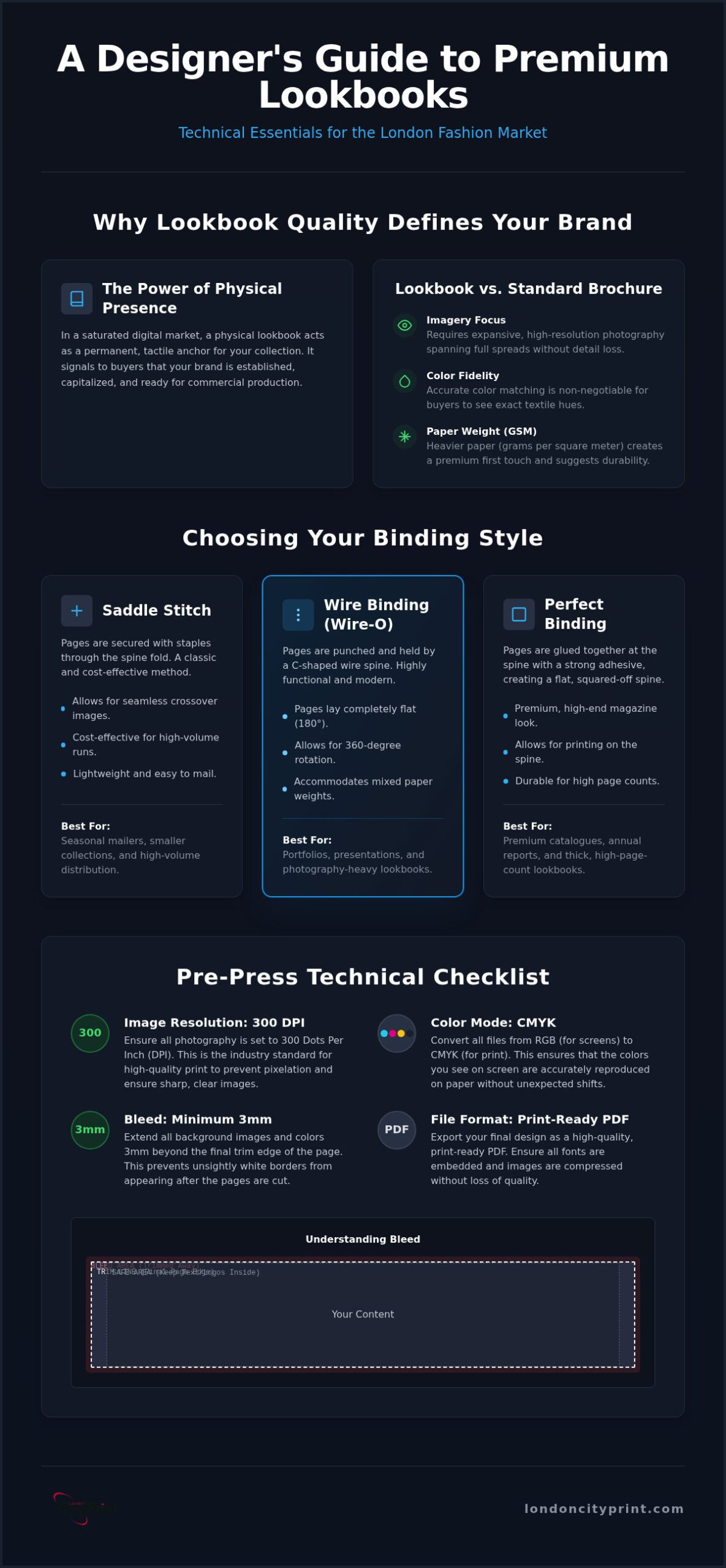
- Imagery Focus: Lookbooks require expansive, high-resolution photography that often spans full spreads without losing detail in the gutter.
- Color Fidelity: Accurate color matching is non-negotiable for fashion buyers who need to see the exact hue of a textile or the subtle undertones of a collection.
- Paper Weight: A heavier cover gsm (grams per square meter) creates a premium “first touch” that suggests durability and long-term value.
Transitioning from a digital portfolio to high-end lookbook printing London allows you to control the environment in which your work is viewed. You dictate the lighting, the texture, and the sequence of the reveal. This ensures your creative vision is never compromised by a low-resolution screen or poor internet connection during a critical meeting.
Wire Binding vs. Saddle Stitch: Comparing Lookbook Binding Styles
Selecting the correct binding for lookbook printing London is a technical decision that dictates how a prospective buyer or editor interacts with your collection. The binding method affects the book’s ability to stay open, its durability under frequent handling, and the overall aesthetic profile of the brand. While digital portfolios are static, a physical lookbook’s functionality is defined by its spine.
We typically categorize lookbook production into three primary finishing styles: saddle stitching, wire binding, and perfect binding. Each serves a distinct purpose based on page count and the desired level of formality. For high-page-count, premium catalogue-style projects, perfect binding (PUR) provides a clean, square-edged spine similar to a high-end magazine. However, for most seasonal collections, the choice often comes down to the versatility of wire versus the tradition of the stitch. If you’re also managing corporate or legal documents alongside your creative work, our professional report binding services guide provides a comprehensive framework for selecting the right binding method under deadline pressure.
When to Choose Professional Wire Binding
Wire binding is the preferred solution for portfolios that require 360-degree rotation. This functionality is vital for photography-heavy lookbooks where details shouldn’t be lost in a traditional gutter. It allows the reader to fold the book back on itself, making it a practical tool for designers during showroom appointments. The “modern industrial” aesthetic of wire-o binding also complements contemporary and streetwear brands that want to project a functional, utilitarian image. Because the wire can accommodate varying paper weights within a single document, you can easily combine heavy-stock dividers with lighter internal pages. For a broader understanding of how different finishing styles serve different professional contexts, our guide to professional document binding London covers the full spectrum of industry styles and how to avoid common finishing errors.
The Classic Appeal of Saddle Stitched Booklets
Saddle stitching involves securing the pages with staples through the fold of the spine. It’s the most cost-effective method for high-volume distribution across London and remains a staple for seasonal mailers. This method achieves a seamless, lightweight finish that feels approachable yet professional. However, technical limitations exist. Thicker books are prone to “creep,” where the inner pages protrude further than the outer ones, requiring precise trimming. If your collection exceeds 48 pages, the book may struggle to stay flat, potentially detracting from the luxury experience.
Choosing the right method depends on your lookbook’s intended lifespan and how it will be used in the field. If you’re preparing for a high-stakes meeting and need a document that stays perfectly flat on a desk, our professional Booklets and Brochures options include technical binding solutions designed for immediate impact. We focus on ensuring the durability of your spine matches the creative vision of your pages.
Selecting Professional Paper Stocks and Finishes
The tactile response of a page is often the first interaction a buyer has with your collection. While binding provides the structure, the paper stock carries the visual weight of your photography. Choosing the right material for lookbook printing London involves balancing aesthetic goals with technical performance. You must consider how different surfaces interact with ink and how the weight of the book feels in a professional showroom environment.
Professional stocks are generally categorized into three primary finishes: gloss, silk, and uncoated. Gloss stocks are the industry standard for high-fashion photography because they provide the highest level of color saturation and contrast. Silk offers a compromise, reducing glare while maintaining sharp detail. Uncoated stocks are increasingly popular for editorial-style lookbooks, providing a natural, textured feel that suggests craftsmanship. However, uncoated paper absorbs more ink, which can soften imagery if not managed correctly during the pre-press stage.
The Science of Colour on Different Paper Stocks
Ink behaves differently depending on the coating of the paper. Gloss coatings keep the ink on the surface, which results in vibrant, punchy colors that make garments pop. This is essential for collections where textile accuracy is paramount. Silk stocks provide a smoother, more sophisticated finish that avoids the high-shine look of gloss, making them ideal for high-end luxury portfolios. If you’re aiming for a muted, artistic aesthetic, premium uncoated papers offer a tactile depth that coated options can’t match. You should anticipate a slight loss in sharpness on uncoated stocks and adjust your image contrast accordingly to maintain visual impact.
Lamination and Durability for London Showrooms
Lookbooks in Central London showrooms endure heavy handling from editors, buyers, and stylists. Without protection, even the best paper will show fingerprints and scuffs. Matt lamination is a standard requirement for professional covers, providing a durable, non-reflective shield. For a more luxurious experience, soft-touch lamination offers a velvet-like texture that invites touch and reinforces a premium brand identity. Spot UV is a technical finishing technique used to add a high-gloss layer to specific areas of a design, such as a logo or a particular garment detail. This creates a visual hierarchy on your cover and adds a sophisticated, multi-dimensional feel to the final product.
Sustainability is a growing priority for many London-based designers. We offer recycled and FSC-certified stocks that maintain high-quality reproduction standards while aligning with eco-conscious brand values. Using these materials doesn’t mean sacrificing clarity. Modern recycled stocks provide excellent results for both digital and lithographic production, ensuring your environmental commitment is visible without compromising on the professional finish of your portfolio. Selecting the right combination of gsm and finish ensures your lookbook printing London project results in a durable, high-impact marketing tool. The same attention to GSM weights, CMYK color profiles, and finish quality that defines a premium lookbook also applies when you need professional business card printing London to complement your collection materials at showroom events.
Technical Checklist: Preparing Your Lookbook Files for Print
Successful lookbook printing London relies on the technical integrity of your artwork. The transition from a digital design to a physical product is a precise manufacturing process. Even the most striking photography will fail if the underlying data isn’t optimized for commercial reprographics. We’ve compiled this checklist to ensure your files move through production without friction or delay.
Your photography must meet a minimum of 300 DPI at the final output size to prevent pixelation. Low-resolution images might look acceptable on a backlit screen, but they’ll appear soft and unprofessional on high-quality silk or gloss stocks. You must also convert all RGB designs to CMYK. Digital screens use light to create color, while printers use ink. Failing to convert your files often leads to significant color shifts, where vibrant screen hues become dull and flat on the page. This is particularly critical for fashion brands where garment color accuracy is a primary requirement.
Managing Bleed and Safe Zones
Precision finishing requires a 3mm bleed for print on all sides of your document. This extra area allows the guillotine to trim your lookbooks without leaving unsightly white edges. You should also maintain a “safe zone” for critical content. Keep all text and important logos at least 5mm away from the trim edge. If you’ve chosen wire binding, you’ll need to increase the inner margin to 10mm or 12mm. This ensures the mechanical punch holes don’t perforate your typography or cut through the center of a model’s face in a full-bleed layout. The same margin and bleed principles apply to academic documents; if you’re also preparing a thesis, our guide to student dissertation printing and binding London covers the specific formatting requirements universities demand.
Exporting Your PDF for Professional Production
The industry standard for error-free production is the PDF/X-4 format. This standard preserves transparency and ensures all fonts are embedded within the file. You should also flatten complex layers to prevent unexpected rendering issues during the RIP (Raster Image Processor) stage. Establishing a clear definition of “print-ready” helps streamline communication between designers and production teams. A print-ready file is a high-resolution PDF that includes 3mm bleed, CMYK color values, and embedded assets, requiring zero manual intervention before it hits the press.
Don’t risk a production delay by submitting incomplete artwork for your collection. If you’re unsure about your layout, our team can review your Booklets and Brochures files to ensure they meet professional standards before we begin the run. We act as your technical partner to ensure the final product is as flawless as your original concept.
London City Print: Same-Day Solutions for Central London Designers
London City Print understands that in the fast-paced world of fashion and design, a week-long delivery window is often a luxury you don’t have. We’ve positioned our production facility in Central London, near the British Museum, to serve as a high-speed hub for creative professionals. Our focus on Booklets and Brochures ensures that your lookbook printing London requirements are handled with technical mastery and immediate responsiveness. We don’t just print files; we provide a dependable support system for corporate and creative clients who are operating under intense pressure.
Our infrastructure is designed to handle scalable solutions that match the lifecycle of a collection. You might require a single-copy prototype for a final internal review before committing to a larger run. We accommodate these small-scale needs with the same level of precision as a full-run production. Being a local Central London partner means you can visit our facility to discuss stocks or collect your order the moment it’s finished. This proximity eliminates the logistical anxiety and potential for damage associated with long-distance shipping and third-party couriers.
Rapid Turnaround for High-Stakes Events
High-stakes industry events like London Fashion Week demand a print partner that operates with a sense of urgency. We specialize in rapid turnaround for urgent portfolio requirements, offering same-day options that allow you to make last-minute revisions without missing your deadline. While online competitors rely on rigid shipping schedules, our local presence enables direct collection or rapid delivery across Central London businesses. This speed doesn’t come at the expense of quality. We maintain a methodical thoroughness even when working against the clock, ensuring every staple, wire, and laminate finish meets our professional standards. Designers attending major events often pair their lookbooks with professionally finished business card printing London services to ensure every touchpoint of their brand presentation is consistent and polished.
Your Indispensable Partner in Print
Our reputation for unwavering professional reliability is built on a foundation of technical precision. The same rigorous attention to detail we apply to court bundle printing London is brought to every creative lookbook we produce. We understand that a misplaced margin or a slight color shift can compromise months of creative work. Our team provides expert consultation at the start of every project to prevent production errors before they reach the press. This proactive approach ensures your vision is translated accurately onto the page. We invite you to contact us for your next bespoke creative project, where we combine technical expertise with a helpful, “can-do” attitude to solve your most complex printing challenges.
Beyond professional document production, if you are navigating the legal system independently, you can learn more about Justice Legal Practice for dedicated support as a litigant in person.
Elevating Your Creative Portfolio for the London Market
Mastering the technical balance between binding durability and paper finish ensures your physical portfolio carries the weight of your creative vision. Whether you choose the lay-flat functionality of wire binding or the classic aesthetic of saddle stitching, every detail contributes to your brand’s authority. Adhering to a rigorous technical checklist prevents common pre-press errors that often compromise high-stakes presentations during busy fashion cycles. Every choice, from paper gsm to lamination, serves as a tactile extension of your craftsmanship.
Securing professional lookbook printing London shouldn’t be a source of logistical stress. Since 2009, we’ve specialized in high-end booklet finishing for corporate and creative clients operating under extreme pressure. Our Central London location near the British Museum allows for rapid collection, ensuring you meet your targets without the risk of shipping delays. Every project includes our expert file-check service to verify your artwork is technically sound before we begin production. This meticulous approach guarantees that your final product matches your digital masters perfectly.
Request a Quote for Professional Lookbook Printing. We’re ready to help you bring your next collection to life with the precision and speed your brand deserves.
Frequently Asked Questions
How quickly can I get lookbook printing in London?
Same-day lookbook printing London is achievable for projects with urgent deadlines. Our Central London facility near the British Museum is optimized for rapid production and immediate collection. We prioritize high-speed reprographics to ensure your portfolio is ready for critical meetings or showroom presentations. This local presence eliminates the delays associated with traditional shipping methods.
What is the best binding style for a fashion lookbook?
The best binding style depends on your page count and functional needs. Wire binding is excellent for portfolios that must lay perfectly flat, while saddle stitching provides a lightweight, seamless finish for slimmer booklets. If your lookbook exceeds 48 pages, wire or perfect binding offers better durability. We’ll help you select the technical finish that best matches your collection’s aesthetic.
Can I print just one copy of my lookbook for a prototype?
We provide single-copy prototypes to allow for a professional review before you commit to a full production run. This service is essential for verifying color accuracy and tactile feel in a real-world format. Testing a physical copy ensures that your final lookbook printing London project meets every technical specification. It’s a vital step for designers who require absolute precision.
What paper weight should I use for a premium lookbook cover?
A premium lookbook typically requires a cover weight between 250gsm and 350gsm. This thickness provides the necessary rigidity and a high-quality “first touch” for the reader. Using a heavier cover stock distinguishes your portfolio from standard brochures. We often recommend adding a matt or soft-touch lamination to these heavier stocks to enhance durability and tactile luxury.
Do you offer wire binding services in Central London?
We offer professional wire binding services at our Central London location. This method is a staple for creative portfolios that feature expansive photography across full spreads. Our facility is equipped to handle varying paper weights and technical binding requirements on-site. You can collect your finished documents directly from our office, which is conveniently located for busy professionals in the city.
How do I set up my files for a lookbook with bleed?
You must include a 3mm bleed on all four sides of your document to ensure a clean trim. All background images and colors should extend into this area to prevent white edges after the final guillotine cut. Additionally, keep all critical text and logos within a 5mm safe zone from the trim edge. This technical setup is essential for professional finishing.
What is the difference between silk and gloss paper for photography?
Gloss paper provides the highest color saturation and contrast, making it the standard choice for vibrant fashion photography. Silk paper offers a smoother finish with reduced glare, which is often preferred for editorial-style layouts where readability is important. Both stocks maintain high-resolution detail, but gloss creates a more punchy, high-shine visual impact. Your choice should align with the mood of your collection.
Can you help with last-minute lookbook printing for an event?
We specialize in managing last-minute printing requirements for high-stakes industry events. Our team understands the logistical pressures of London Fashion Week and product launches. We maintain a responsive, “can-do” attitude to help you navigate tight deadlines without compromising on technical quality. Contact us directly to discuss your urgent timeline and secure a rapid production slot.








3 comments
Comments are closed.